


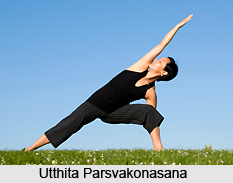
 Utthita Parsavakonasana is a cultural yoga posture that is effective in fighting several ailments, and creates a stretching effect along the top side of the body, from the back hell through the raised arm. It is especially helpful in alleviating pain in the lower back. Utthita Parsavakonasana is a cultural yoga posture that is effective in fighting several ailments, and creates a stretching effect along the top side of the body, from the back hell through the raised arm. It is especially helpful in alleviating pain in the lower back.
Meaning of Utthita Parsvakonasana Utthita Parsavakonasana, in Sanskrit, means extended side angle pose, (utthita = extended, parsava = side, konasana angle pose). The asana derives its name from the final posture that resembles a 'lambda' sign, with one arm stretched far to the other side while the legs are spread out. Practice of Utthita Parsvakonasana A sequential procedure for performing Utthita Parsvakonasana follows: * To begin with this asana, stand in Tadasana. * With an exhalation, step or lightly jump to place the feet 31/2 to 4 feet apart. * Raise the arms parallel to the floor and reach them actively out to the sides, shoulder blades wide, palms down. * Turn the left foot in slightly to the right and the right foot out to the right 90 degrees. Align the right heel with the left heel. * Firm the thighs and turn your right thigh outward, so that the center of the kneecap is in line with the center of the right ankle. * Roll the left hip slightly forward, toward the right, but rotate upper torso back to the left. * Anchor the left (back) heel to the floor by lifting the inner left groin deep into the pelvis. Then exhale and bend the right knee over the right ankle, so that the shin is perpendicular to the floor. * As the knee is bent, aim the inner knee toward the little-toe side of the foot. If possible, bring the right thigh parallel to the floor. * As one continues to ground your left heel to the floor, exhale and lay the right side of the torso down onto (or bring it as close as possible to) the top of the right thigh. * Press the right fingertips (or palm) on the floor just outside of the right foot. * Actively push the right knee back against the inner arm; counter this by burrowing the tail bone into the back of the pelvis, toward the pubis. The inside of the right thigh should be parallel with the long edge of your sticky mat. * Firm the shoulder blades against the back ribs. * Extend the left arm straight up toward the ceiling, then turn the left palm to face toward the head and with an inhalation reach the arm over the back of your left ear, palm facing the floor. * Stretch from the left heel through the left fingertips, lengthening the entire left side of the body. Turn the head to look at the left arm. * Release the right shoulder away from the ear. Try to create as much length along the right side of the torso as you do along the left. * Stay for 30 seconds to 1 minute. Inhale to come up. * Push both heels strongly into the floor and reach the left arm forcefully toward the ceiling to lighten the upward movement. * Reverse the feet and repeat for the same length of time to the left. Then come up and return to Tadasana. The Anatomical Focus points on the body for this asana are Legs, Ankles, Groins, Chest , Lungs , Shoulders , Spine and Abdomen. Effects of Utthita Parsvakonasana * Strengthens and stretches the legs, knees, and ankles * Stretches the groins, spine, waist, chest and lungs, and shoulders * Stimulates abdominal organs Increases stamina Precautions in practice of Utthita Parsvakonasana This asana should not be practised for the patients of headache, High or low blood pressure and insomnia. If one has any neck problems don't turn the head to look at the top arm; instead look straight ahead with the sides of the neck lengthened evenly, or look down at the floor. |
| |||



Home > Health > Yoga > Yoga Asanas > Types of Yoga Asanas > Cultural Asanas > Utthita Parsvakonasana
Utthita Parsvakonasana
| Utthita Parsvakonasana is a cultural asana that translates to `extended side angle pose`, and is good for constipation, infertility, backache and sciatica. |
| ||||||||||||||||||||||||||||

