


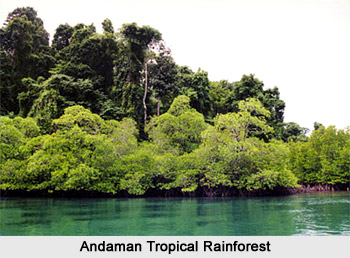
 These forests can be characterized by high rainfall, with rainfall of 100 to 600 centimeters per year. The soil in these forests can be soft and with less resistance power, because high rainfall tends to leach out the soluble nutrients. These forests flourish in or close to the tropics, the hot regions that lay either side of the equator and the atmosphere in a tropical rainforest is permanently humid - damp and hot. The tropical rainforests are often referred to as jungles in India, which is a Hindi word meaning wilderness. A true jungle is a thick mesh of vegetation, through which people have to force and cut their way. Though the tropical rainforests contain patches of jungle, they are more open. The tropical rainforests have between five and twenty times as many species of trees as one in the temperate zone of North America or Europe. They also provide a home for a number of the most fascinating animals of the world. These forests can be characterized by high rainfall, with rainfall of 100 to 600 centimeters per year. The soil in these forests can be soft and with less resistance power, because high rainfall tends to leach out the soluble nutrients. These forests flourish in or close to the tropics, the hot regions that lay either side of the equator and the atmosphere in a tropical rainforest is permanently humid - damp and hot. The tropical rainforests are often referred to as jungles in India, which is a Hindi word meaning wilderness. A true jungle is a thick mesh of vegetation, through which people have to force and cut their way. Though the tropical rainforests contain patches of jungle, they are more open. The tropical rainforests have between five and twenty times as many species of trees as one in the temperate zone of North America or Europe. They also provide a home for a number of the most fascinating animals of the world.
Tropical rainforests hold a large variety of substances potentially useful to humans. Many of the human foods and medicines and also several useful timbers are collected from them. All the products like coffee, papayas, bananas, chocolate, mangoes, avocados and sugarcaneoriginally came from tropical rainforests, and are still mostly grown on plantations in regions that were formerly primary forest. The trees in the tropical rainforests are very tall and broadleaved evergreens and the floor of the forests remain covered with the rotting leaves. The tallest trees have buttress roots and wing-like growths that spread out from the base of the trunk to act as props. The other trees have stilt roots that grow down from the branches or trunk, often in graceful arches. All the trees in these forests carry their branches and leaves at the top of long slender trunks, forming a huge umbrella-like green canopy. The dense canopy filters much of the daylight and leaves a shady green world beneath it. The tropical rainforests possess more diverse species of plants and animals than any other part of the world, even more than the oceans that cover nearly three-quarters of the earth. The rainforests give shelters to two-thirds of all the living animal and plant species on the planet. It has been estimated that hundreds of millions of new species of plants, insects, and microorganisms are still undiscovered and yet unnamed by science. The tropical rain forests are also called the 'jewel of the earth', and the 'world's largest pharmacy', as large amount of natural medicines have been discovered there, so far. A large amount of prescription drugs sold worldwide come from plant-derived sources in the tropical rainforests and the scientists believe that the cures for many more diseases will be discovered there in the future. Various common characteristics can be found in the trees of tropical rainforests. The tropical rainforest species frequently possess one or more attributes not commonly seen in trees of higher latitudes or trees in drier conditions on the same latitude. Some of the most notable plants found in the tropical rainforest include the Bengal Bamboo, Bougainvillea tree, Coconut tree, Curare, Durian, Jambu, Mangrove forests, Strangler figs, Kapok tree and Tualang. While the Bengal Bamboo is found in southern Asia, the Bougainvillea is found in South America and the Coconut tree is found in hot places like Africa and Asia. The Durian is found in southern Asia; the Jambu somewhere in southern India to eastern Malaya, the Kapok tree in the emergent in the South of Asia and the Mangrove forest is found in the south of Asia. While the Strangler fig is found in southern Asia, the Tualang is found in southern Asia. A large number of tree species found in the tropical rainforests have broad, woody flanges (buttresses) at the base of the trunk. Large leaves are common among the trees and shrubs of the forest floor layers and the young trees destined for the canopy and emergent layers also sometimes have large leaves. The large leaves surfaces help intercept light in the sun-dappled lower strata of the forest. The canopy leaves are usually smaller than those found in understory plants and are divided to reduce wind damage. The trees are often well connected in the canopy layer, especially by the growth of woody climbers known as lianas, or by plants with epiphytic adaptations. The other principal characteristics of the trees in tropical rainforests include exceptionally thin bark. The bark is often only one to two millimeters thick and it is usually very smooth, although sometimes covered with thorns or spines. Another common tree in tropical rainforests is Cauliflory that flowers and hence fruits directly from the trunk, rather than at the tips of branches. Large fleshy fruits that attract birds, mammals, and even fish as dispersal agents, are also a common characteristic of the trees in tropical rainforests. At present, one of the largest economic values of tropical rainforests comes in the form of tourism. People roam nationally as well as internationally to get a first hand experience of the tropical rainforests. Tourism of the rainforests offers considerable economic benefits which will help in preserving it. The state of Arunachal Pradesh in India is the long surviving tropical rainforest. It is having tremendous wealth of forested land and wildlife. The increase in population, encroachments and hunting caused the destruction of the forest lands in India. Presently, India's north-eastern states are the only portions where tropical rainforests survive. |
| |||



Tropical Rain Forest
| Tropical Rain Forest offer a suitable opportunity for tourism and in India this type of forest is found in the state of Arunachal Pradesh, Meghalaya, Nagaland, Assam, Tripura, West Bengal, Western Ghats and Andaman and Nicobar Islands. |
| ||||||||||||||||||||||||||||

