Qawwali: Qawwali is a vibrant musical tradition of India, which stretches back more than 700 years. It is a kind of devotional music performed mainly at Sufi shrines throughout what is now India and Pakistan, and has also gained mainstream popularity. The Qawwali songs are mostly heard in Urdu language and the Punjabi language, but they are also available in Persian, Brajbhasha and Siraiki. Qawwali can also be enjoyed in some regional languages but the sound of it is quite different from the conventional counterpart. The central themes of qawwali are love, devotion and longing (of man for the Divine). Songs in Qawwali are usually between 15 to 30 minutes long. It is performed with one or two lead singers, several chorus singers, harmonium, tabla, and dholak. The principles of Qawali music are based on Hindustani Classical music.
Ghazal: A Ghazal is a poetic form consisting of couplets, which share a rhyme and a refrain. The word means `the mortal cry of a Kastori doe`. A Ghazal, thus, is a collection of couplets (called sher), which follow the rules of Matla, Maqta, Beher, Qafiya, Radif, Khayaal and Wazan. The traditional complete ghazal has a matla, a maqta, and three other shers in between. The first two shers of a ghazal have the form of a qatha. Strictly speaking, it is not a musical form, but a poetic recitation. Today, however, it is commonly conceived of as an Urdu song, with prime importance given to the lyrics. In some modernized ghazals the poet`s name is hidden somewhere in the last verse, usually between the front and end of a word. The ghazal is a common song form in India and Pakistan today.
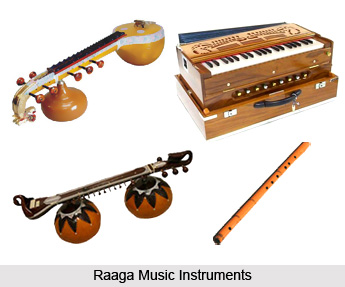
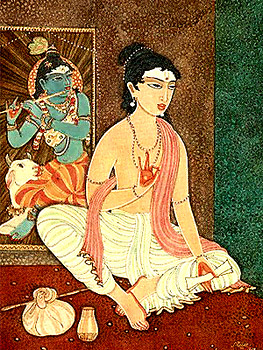
 Bhajan and Kirtan: A bhajan or kirtan is a Hindu devotional song, often of ancient origin. A lot of importance is attached to the singing of Bhajans with Bhakti, i.e., with loving devotion. Kirtans are deeply rooted in the tradition of the Veda. Bhajans are often simple songs in lyrical language expressing emotions of love for the Divine, either for a single God/Goddess, or any number of divinities. Many bhajans feature several names and aspects of the chosen deity, especially in the case of Hindu sahasranamas, which list a divinity`s 1008 names. Traditionally, the music is based on Indian classical music, which is based on ragas and tala (rhythmic beat patterns) played on the Veena, Sarangi, Venu (flute), Mridanga (or Tabla) (traditional Indian instruments). The Scripture of the Sikhs contains 31 ragas and 17 talas, which form the basis for kirtan music compositions. Various traditions of bhajan-singing, such as Nirguni, Gorakhanathi, Vallabhapanthi, Ashtachhap and Madhura-bhakti, have been formed over the ages. Each sect has their own sets of bhajans and methods of singing. The traditional form of bhajan in South India is known as Sampradya Bhajans. In the past few decades, this has seen a great upsurge in popularity.
Shabad: Shabad is a style similar to bhajan, but these are more popular among the Sikhs. Shabad literally means word, generally from the Guru Granth Sahib, which is the holy book of the Sikhs. The shabad has historically been performed in very traditional styles. The Guru Granth Sahib is very specific in the ragas that the various shabads are to be sung in. These are very typical of the more classical ragas of North Indian Classical music (Hindustani Sangeet). The traditional shabads are also in the more classical tals, such as teental and ektaal. Special classes of performers sing the shabads and they are known as raagis. In the modern times, however the shabad is performed in lighter forms. The latitude that is sometimes taken is very great. Some merely perform the shabad in ragas different from those specified in the Guru Granth Sahib. Sometimes the light forms tend to resemble film songs, or folk songs, rather than the austere and meditative ragas specified in the Guru Granth Sahib.
Bhavageete: Bhavageete literally means emotional song. It is a kind of expressionist poetry and light music. This music form is popular in the states of Maharashtra and Karnataka. The Kannada Bhavageete draws from Kannada language poetry whereas Marathi Bhavageete drawas from Marathi language poetry. Most of the poetry sung in this genre pertains to subjects like love, nature, philosophy etc, and the genre itself is not much different from Ghazals, though ghazals are bound to a peculiar metre.
Ganasangeet: Ganasangeet is generally sung in chorus and carries some social message. The songs are usually about freedom, community strength and patriotism. Due to the British occupation in India, a lot of protest songs about anti-imperialism/pro-socialism have been written in India. These are the main forms of Ganasangeet.
Thus discussed above is a brief review of the various traditional music forms in India.