





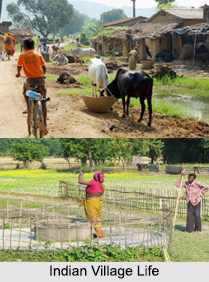
 Indian Village Life is usually free from the chaos and pandemonium that is so prevalent in the cities. It is the tranquillity, serenity and calmness offered by the village life that is enchanting. The people in the Indian villages are primarily poor who make their living through agriculture and other small scale and cottage industries and are dependent on nature and other human forces to a great extent. Indian Village Life is usually free from the chaos and pandemonium that is so prevalent in the cities. It is the tranquillity, serenity and calmness offered by the village life that is enchanting. The people in the Indian villages are primarily poor who make their living through agriculture and other small scale and cottage industries and are dependent on nature and other human forces to a great extent.
The economy of the nation has banked upon its agrarian society from the time of the British rule in 1947. A majority of the persons living in India have involved themselves in agriculture and associated industries, and have thus made the country the quickest developing world economy. Indian village life is fully relied on agriculture and innate all over the land. The lifestyle maintained by the people of Indian villages as well as their working styles are as fascinating as the metropolitan city lifestyles. Occupation in Indian Villages The primary occupation of the people living in the Indian villages is agriculture and is therefore reckoned as an unchangeable part of the Indian village culture. The caste system which originated long back has however remained unchanged in the village life in India. Although, caste system in its original sense has collapsed yet caste identities are very much present there in the village life in India. People belonging to different castes in a village deal with each other in kinship terms, which shows the fictive kinship relationships distinguished within each settlement. Culture and Tradition in Indian Villages Habitually the Indian villagers manifest a deep loyalty to their villages. The uniqueness of the village life in India lies in this deep loyalty which is again marked with a rich culture. The mystic charm and the cultural diversities of the village life in India make Indian villages the land where beauty never fades away. 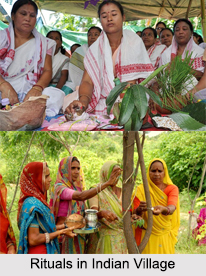
The village life in India is idyllic, unchanging with its immense beauty. The villagers of India are normally habituated in sharing and using the common facilities of the village including the village shrines and temples, the village pond, schools, grazing grounds, sitting places, etc. This interdependence of the village life in India perhaps provides a matchless unity amongst the villagers which supports them in surviving amidst thousands of odds. Village unity is therefore the primary concern of the village life in India. Rituals in Indian Villages Characteristically, each of the Indian villages recognizes a particular deity as the protector of the concerned village and the people of that village get together to worship the deity. The uninterrupted village life in India entertain themselves amidst the colour of the festivals like Diwali, Holi, Muharram, Dussehra, etc, in the captivating pulse of dance and songs and of course in the emotion of rural theatres. Administration in Indian Villages In Indian villages, there is a headman who is recognized often to respectfully listen to the village Panchayat’s decision. The gram panchayat comprises of some important men from the major castes of the village. The panchayat in Indian villages are responsible to clarify the disputes within the village boundaries as much as possible, with occasional choices of the interference of police or the court system. In the recent era, the Government supports an elective Panchayat system in the Indian villages. Development of Indian Villages Continuous reforms are made by the government in order to fashion the country a ‘motor’ for the economy of the world. Developments in the agrarian infrastructure, public sector reforms, rural development, righted labour norms, etc have changed the Indian village life. The Government of India helped the villages with advanced technology for farming implements and presently most of the villages in India have access to modern farming equipments. Now-a-days, the Indian village outskirts boast up with food packaging plants, textile industries, sugar industries and steel plants. These have created for the village youth suitable employment opportunities. The village life in India blessed with its innocence, purity and uncomplicated saga makes the villages as quaint, archaic, mystic yet charming places to rediscover nature. |
| ||||||||||||||||||||||||||||

