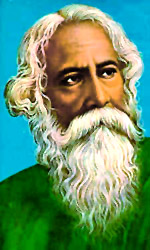
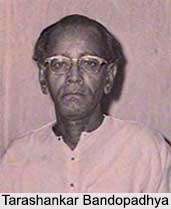
 Tarashankar Bandopadhya is grouped with those writers of the third decades of the 20th centuries who broke the poetic tradition in novels but took to writing prose with the world around them. He was one of the leading Bengali novelists who wrote 65 novels, 53-story-books, 12 plays, 4 essay-books, 4 autobiographies and 2 travel stories. He directed one Bengali feature film (Amrapali) in 1959.
Birth of Tarashankar Bandopadhya
Tarashankar Bandopadhya was born on 23rd July 1898 at his ancestral home at Labhpur village in Birbhum district to Haridas Bandyopadhyay and Prabhabati Devi.
He passed the Matriculation examination from Labhpur Jadablal H. E. School in 1916 and was later admitted first to St. Xavier`s College, Kolkata and then to South Suburban College (now Asutosh College). While studying in intermediate at St. Xavier`s College, he joined the non-co-operation movement. He could not complete his university course due to ill health and political activism.
Works of Tarashankar Bandopadhya
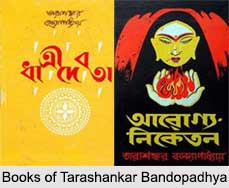
Tarasankar`s novels accepted realism in a new approach allowing the reader to breathe the truth of human relationship limited so far by the conservative and hypocrisy of the then society. His celebrated novels are "Dhatridebta", "Kalindi", "Panchagrm", "Gonodebata", "Kabi", "Arogyaniketan", "Jalsaghar", "Raskali", "Hansulibaker Upakatha" and so on. His novels are rich in material and potentials. He proved that sexual relation between man and women sometimes take over to such a level that it can take an upper hand over the existing laws and instructions of society. His novel `Radha` can be set for an instance in this context. Most of his early short stories were published in periodicals "Bangasri" and "Prabasi".
 Tarashankar Bandopadhya in Freedom Struggle
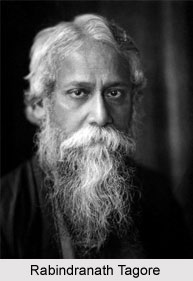
Tarashankar Bandopadhya was arrested in 1930 for actively supporting the Indian independence movement, but released later that year. After that he decided to dedicate himself to literature. In 1932, he met Rabindranath Tagore at Shantiniketan for the first time. In 1942, he presided over the Birbhum District Literature Conference and became the president of the Anti-Fascist Writers and Artists Association in Bengal. In 1944, he presided over the Kanpur Bengali Literature Conference arranged by the non-resident Bengalis living there. In 1947, he inaugurated "Prabasi Banga Sahitya Sammelan" held in Kolkata and received Sarat Memorial Medal from the University of Calcutta. In 1948, he moved to his own house at Tala Park, Kolkata.
In 1952, he was nominated to be a member of the legislative assembly. He was a member of the West Bengal Vidhan Parishad between 1952-60. He was a member of Rajya Sabha between 1960–66. In 1966, he retired from the Parliament and presided over Nagpur Bengali Literature Conference.
Awards of Tarashankar Bandopadhya
Tarashankar Bandopadhya was awarded Rabindra Puraskar, Sahitya Akademi Award, Jnanpith Award, Padma Shri and Padma Bhushan.
Personal Life of Tarashankar Bandopadhya
Tarashankar Bandopadhya was married to Umashashi Devi in 1916. Their eldest son Sanatkumar Bandyopadhyay was born in 1918; the youngest son Saritkumar Bandyopadhyay was born in 1922; the eldest daughter Ganga was born in 1924; the second daughter Bulu was born in 1926 but died in 1932; the youngest daughter Bani was born in 1932.
Death of Tarashankar Bandopadhya
Tarashankar Bandopadhya died at his Kolkata house early in the morning on 14th September 1971. His last rituals were performed at the Nimtala Cremation Ground, North Kolkata.