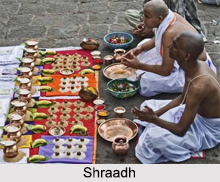
 Shraadh is a ritualistic custom unique to the Hindu religion observed after the `Antyesthi` or death ceremony. It is a ceremony to offer prayers of loving homage to the departed and to remember his/ her memories. This ceremony is generally performed at home. The relatives and friends are invited to join the rituals and later they are served a meal. The son or heir of the deceased also performs the Shraadh annually.
The sons or the grandsons of the departed person pay respectful homage to their deceased parents and grand parents by performing this ritual. It is believed that after the performance of the ritual, the soul of the dead relative is appeased and it attains Moksha. Shraddh liberates the ancestors, since the mantras chanted during Shraddh ceremony, reaches the dead ancestors soul through the atmosphere and space. This day is also thought of as a day of remembering the ancestors and parents.
Hindu Shastras mention that Shraadh karmas should be done for at least 3 generations which include father, grandfather and great grandfather; and the other family members in their generations. Whichever of the family members are dead in these generations, Shraadh can be done for them, but it is compulsory to do Shraadh for father, grandfather, great grandfather and respective wives of all three of them, whichever of them are dead.
Significance of Shraadh
The ancient Hindu scriptures like the Vedas and Puranas like Agni Purana, Garuda Purana, Vayu Purana, etc. explain the significance of Shraadh. Hindus believe that after death the soul or `Atma` leaves the physical body or `Sthula Sarira` with a vehicle called `Linga Sarira` or subtle body, sometimes referred as `Angushtha Matra`. This soul or Preta is consequently in a restless, uncomfortable plight and is considered as impure until and unless the first shraadh is performed.
To satisfy the deceased soul, the Shraadh ritual is done on certain day after death and it is performed again at the end of the month and end of the year. The heirs also perform `Tarpan`; thus they invite their ancestor soul to take part in the pilgrimage with them and share their bliss.
Performance of Shraadh
Shraadh is performed on 10th, 13th, 15th, 20th or 30th day after death. The day chosen entirely depends on the custom of that community. During the Shraadh, food and water is offered to the departed soul. This is known as `Pinda`. The priest utters sacred hymns. According to the rituals, the visitors who attend the Shraadh must not wear bright coloured clothing. There should be an absolute silence even when offering condolence. Although it is a sad occasion crying is not allowed as crying is considered as a disturbance. During offering condolence one can touch the hand of the members of the deceased person"s family if they are of same sex. If donations are given they must not be handed directly to the immediate member of the grieving family but can be handed through other relatives.
The Shraadh is also done on annual basis in the death anniversary following the Hindu calendar. Shraadh on the day of Mahalaya is done in a fortnight called `Pitri Paksha`. Shraadh can also be performed on every New Moon day or " Amavasya". During this fortnight, in the memory of the loved bygones their favourite food is eaten and the good time passed with them is remembered. The family members pray that their soul rest in eternal peace.
During the period of the Shraadh, the relatives of the deceased only take vegetables, protein-less food, and sunned rice without salt. Sons of the deceased shave their head on the day prior to Shraadh and observe various rituals. On the day of the obsequies, the karta treats his family, the priests and even the neighbours to a feast prepared according to their means. People also donate clothes and other items to Brahmins and relations. A Shraadh is actually performed for three generations of Pitris (the father, the grand-father and the great grand-father), or to all Pitris. Three cakes are offered to the father, grandfather and great grandfather.
During the Shraadh offerings of round balls of rice, flour along with accompaniments of sacred grass, flowers is made, along with repetitions of mantras and texts from the Sam Veda. The entire ceremony is conducted at any sacred spot such as the margin of a river. A person who performs Shraadh is known as the "Karta" and he invites Brahmins on that day and performs a "Homa" as way of expressing his heartfelt gratitude and thanks to his parents and ancestors. The karta offers food to the Pitra by putting cooked rice and vegetable into the fire in very small quantities and also adding just a small piece of cooked vegetable. He serves and treats them with all hospitality and finally does "pinda Pradaana". The Brahmin priest helps the Karta to perform the ritual.
Similarly, there are a series of actions to be performed and karta repeats the mantras after the priest and performs the actions as instructed by the former. In addition, to the main priest, two more brahmins are invited to the house during the ritual. Through mantras, one is nominated as the Pitra and the other as the guide; hence the karta is supposed to imagine they are his own father, grandfather and great grandfather and treat them as such with all respect. After the ritual is over, the Karta then gives "dakshina" to the priests and only after the consent of the priests, he and his family have the food. The karta also shows respect to the Brahmins, like giving a foot-wash and dress consisting of cotton dhoti.
There are 12 types of Shraadh in the Hindu religion. These are explained as follows:
1. Nitya Shraadh: In this ceremony sesame seeds, grains, water, milk, fruit, vegetables and food are offered to the departed soul daily.
2. Neimitik Shraadh: It is also known as Ekodisht Shraadh and here, food is offered to an odd number of priests say 1, 3, or 5 in number.
3. Kaamya Shraadh: Here, prayers and respect is offered to the departed soul with the aim of fulfilment of some wish.
4. Vriddhi Shraadh: It is done for gain of prosperity and children. Only those people who have gone through Upanayan Samskar should perform it.
5. Sapindan Shraadh: Here four clean vessels are taken and in each some water mixed with fragrance and sesame seeds is taken. These four are symbolic of Pretaatma (wandering spirits), Pitaatmaa (spirits of higher souls), Devaatmaa (spirits which are divine) and other unknown souls. Then the water from the first vessel is poured into the second.
6. Paarvann Shraadh: It is done on a moonless night or on some special occasion.
7. Goshtth Shraadh: It is done for the gain of cattle.
8. Shurdhyarth Shraadh: It is done with the help of priests for gain of wealth, amd for appeasing scholars and ancestors.
9. Karmaang Shraadh: Here, prayers are offered to the ancestors when a woman becomes pregnant or when Seemaantonayan and Punsavan Samskars are being accomplished.
10. Deivik Shraadh: Here, oblations are made with ghee in the holy fire for good luck in travels and to seek the well wishes of deities.
11. Oupcharik Shraadh: It is done for physical health and riddance from diseases.
12. Saanvatsarik Shraadh: It is the best among all Shraadhs and it is accomplished on the day on which the soul departed. It is a very important ritual for in the text Bhavishya Purann Lord Sun says - I do not accept the prayers of a person who does not perform Saanvatsarik Shraadh and neither do Vishnu, Brahma, Rudra and other deities.
Hence, one should surely carry out this ritual each year on the day the ancestor passed away. Since Shraadh is one of the most important it is imperative that the karta should perform the same, with faith, devotion and reverence. Only then, will the true intent of the ritual be fulfilled and the performer of the ritual feel completely gratified. The ceremonies performed during Pitr-Paksha have very special effects. According to a legend, the offerings during the Shraadh to the departed reach the "Pitris" immediately, due to a boon from Lord Yama (the God of death). It is also stated in the texts that a person who does not accomplish the Shraadh of his dead parents has to suffer much in life and even after. He may even be born in lower planes of existence as a result.