


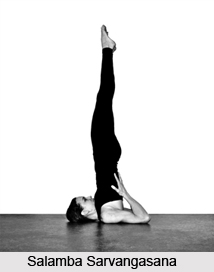
 Salamba Sarvangasana is a derivative of the Sarvangasana, an important cultural yoga asana. It is therapeutic in a range of illnesses and must be performed carefully, given that it is an inverted posture. The asana is effective in treating asthma and sinusitis. Salamba Sarvangasana is a derivative of the Sarvangasana, an important cultural yoga asana. It is therapeutic in a range of illnesses and must be performed carefully, given that it is an inverted posture. The asana is effective in treating asthma and sinusitis.
Meaning of Salamba Sarvangasana The literal meaning of Salamba is "support". Sarva means "all". Anga refers to "limb". This version of the shoulder stand is performed with a blanket for support under the shoulders. Practice of Salamba Sarvangasana * Fold two or more firm blankets into rectangles measuring about 1 foot by 2 feet, and stack them one on top of the other. Place a sticky mat over the blankets to help the upper arms stay in place while in the pose. Then lie on the blankets with shoulders supported (and parallel to one of the longer edges) and the head on the floor. Lay the arms on the floor alongside the torso, then bend knees and set feet against the floor with the heels close to the sitting bones. * Exhale, press arms against the floor, and push feet away from the floor, drawing thighs into the front torso. * Continue to lift by curling the pelvis and then the back torso away from the floor, so that the knees come toward the face. * Stretch the arms out parallel to the edge of the blanket and turn them outward so the fingers press against the floor (and the thumbs point behind). * Bend elbows and draw them toward each other. * Lay the backs of the upper arms on the blanket and spread the palms against the back of the torso. * Raise the pelvis over the shoulders, so that the torso is relatively perpendicular to the floor. * Walk the hands up the back (toward the floor) without letting the elbows slide too much wider than shoulder width. * Inhale and lift bent knees toward the ceiling, bringing the thighs in line with the torso and hanging the heels down by the buttocks. * Press the tailbone toward the pubis and turn the upper thighs inward slightly. * Finally inhale and straighten the knees, pressing the heels up toward the ceiling. * When the backs of the legs are fully lengthened, lift through the balls of the big toes so the inner legs are slightly longer than the outer. * Soften the throat and tongue. Firm the shoulder blades against the back, and move the sternum toward the chin. The forehead should be relatively parallel to the floor, the chin perpendicular. * Press the backs of the upper arms and the tops of the shoulders actively into the blanket support, and try to lift the upper spine away from the floor. * As a beginning practitioner stay in the pose for about 30 seconds. Gradually add 5 to 10 seconds to the stay every day or so until the pose can be held comfortably for 3 minutes. * Then continue for 3 minutes each day for a week or two, until the pose is relatively comfortable Again gradually add 5 to 10 seconds to the practice every day or so until the pose can be held for 5 minutes. * To come down, exhale, bend the knees into the torso again, and roll the back torso slowly and carefully onto the floor, keeping the back of the head on the floor. Effects of Salamba Svargasana * Calms the brain and helps relieve stress and mild depression. * Stimulates the thyroid and prostate glands and abdominal organs. * Stretches the shoulders and neck. * Tones the legs and buttocks. * Improves digestion. * Helps relieve the symptoms of menopause. * Reduces fatigue and alleviates insomnia. Precautions in the practice of Salamba Sarvangasana Salamba Sarvangasana is considered to be an intermediate to advanced pose. Do not perform this pose without sufficient prior experience or the supervision of an experienced instructor. Some schools of yoga recommend doing Salamba Sirsasana before Salamba Sarvangasana, others vice versa. * The asana is not recommended for pregnant ladies. * This asana should not be performed when suffering from diarrhoea, headache, high blood pressure, menstruation and neck injury. * Rolling up into Sarvangasana from the floor might be difficult at first. The practitioner can use a wall to help get into the pose. * Set blankets up a foot or so from the wall (the exact distance depends on the height: Taller students will be farther from the wall, shorter students closer). * Sit sideways on the support (with one side toward the wall) and, on an exhalation, swing the shoulders down onto the edge of the blanket and legs up onto the wall. * Bend the knees to right angles, push the feet against the wall and lift the pelvis off the support. When the torso and thighs are perpendicular to the floor, lift the feet away from the wall and complete the pose. |
| |||



Salamba Sarvangasana
| Salamba Sarvangasana is a cultural yoga asana that is therapeutic for asthma and sinusitis, and is derived from the Sarvangasana, a prominent yoga posture. |
| ||||||||||||||||||||||||||||

