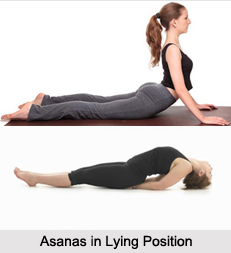
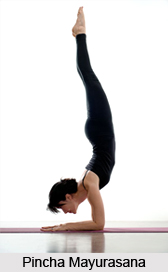
 Pincha Mayurasana is a cultural asana derived from Mayurasana, a major yoga asana. It improves the sense of balance and strengthens the muscles of the shoulders, back and arms.
Meaning of Pincha Mayurasana
Mayurasana is the peacock pose. "Pincha Mayurasana" is called the feathered peacock asana, identifying with the union of terms Pincha (i.e. feathers) and Mayura (peacock). The body in this posture resembles a peacock with feathers fully spread and dancing. It is commonly known as forearm or elbow balance. Being much similar to asanas such as Handstand Balance and Headstand, a major obstacle to Pincha Mayurasana is a natural fear of falling. Therefore, the basic pose will be described with the heels supported against a wall. Often the hands slide together during this pose which collapses the head onto the floor and compresses the neck.
Practice of Pincha Mayurasana
•Perform a modified Adho Mukha Svanasana at the yoga wall, with the palms and forearms on the floor. The fingertips should be right at the base of the wall, and the forearms parallel to each other at shoulder width.
•To ready and secure oneself in this inversion, firm the shoulder blades against the back torso and pull them toward the tailbone.
•Then rotate the upper arms outward, to keep the shoulder blades broad, and hug the forearms inward.
•Finally spread the palms and press the inner wrists firmly against the floor.
•Now bend one knee and step the foot in, closer to the wall (let`s say the left leg), but keep the other (i.e. right) leg active by extending through the heel.
•Take a few practice hops before trying to launch oneself upside down.
•Sweep the right leg through a wide arc toward the wall and kick the left foot off the floor, immediately pushing through the heel to straighten the leg.
•Hop up and down like this several times, each time pushing off the floor a little higher.
•Exhale deeply for each hop.
•Stay in the pose 10 to 15 seconds. Gradually increase this to 1 minute.
•When coming down, be sure not to sink onto the shoulders. Keep the shoulder blades lifted and broad, and take one foot down at a time with an exhalation.
•Lift into Adho Mukha Svanasana for 30 seconds to a minute. Be sure to alternate the kicking leg, one day right, next day left.
The anatomical focus points of the body are Brain, Pituitary, Arms, Shoulders, Legs, Spine and lungs. Hopping up and down is all that will be manageable in the beginning. Regularly practice strength poses, like Adho Mukha Svanasana and Chaturanga Dandasana. Eventually one will be able to kick all the way into the pose. At first the heels may crash into the wall, but again with more practice the practitioner will be able to swing the heels up lightly to the wall.
If the armpits and groin are tight, the lower back may be deeply arched. To lengthen it, draw the front ribs into the torso, reach the tailbone toward the heels, and slide the heels higher up the wall. Draw the navel toward the spine. Squeeze the outer legs together and roll the thighs in. In Pincha Mayurasana the head should be off the floor; hang it from a spot between the shoulders.
Effects of Pinchamayurasana
•Like handstand and headstand asanas, it improves sense of balance
•The shoulders, arms, and back get immensely strengthened.
•It stretches the shoulders and neck, chest, and belly.
•Calms the brain and helps relieve stress and mild depression
Precautions in the practice of Pinchamayurasana
One should not perform this asana when suffering with back, shoulder, or neck injury, headache, heart disorders, high blood pressure and menstruation.