





 Photography in India now-a-days is used almost in every field that needs documentation, both for professional and private purposes. Indian photography has really advanced with the paradigm shifts, and with the advent of digital camera, its usage has broadened, perhaps beyond imagination. Photography as a career also has gained a huge impetuous in India. The present booming expanding structure of Indian newspapers, be it in any category, is hugely profitable. Photography in India now-a-days is used almost in every field that needs documentation, both for professional and private purposes. Indian photography has really advanced with the paradigm shifts, and with the advent of digital camera, its usage has broadened, perhaps beyond imagination. Photography as a career also has gained a huge impetuous in India. The present booming expanding structure of Indian newspapers, be it in any category, is hugely profitable.
A reader is automatically attracted to that very special news section containing a meaningful, captivating picture. As such, photojournalists with a keen sense of the inner feel and flair for photographing anything and everything exciting to the onlooker are under great demand. Photojournalism in India is indeed quite lucrative, provided one is determined to make it to the top. History of Indian Photography The severe arrival of Photographic art appeared in India under the revived wave of the Colonial Powers. The East India Company announced Photography as the most precise and economical means of recording of the architectural and archaeological monuments for executive records, travellers etc. 'The Bombay Photographic Society' was formed in 1854 with the 200 members and the similar bodies were formed in Chennai and Kolkata in 1856 tied to the colonial government. A key incident in the development of photography in India is the public interest about India in Britain which created a boosted market for photographs on the culture and lifestyle of India. In the 19th century, India was at the front line of photographic enlargement and a wide range of eye-catching images about India had been captured by the photographers. Genres of Indian Photography Photography is one of the best ways to preserve the memories, to cherish the long gone moments. Following are the different types of Indian Photography: • Fashion Photography: Fashion Photography is one of the largely required after careers. Fashion photography is a genre of photography which is dedicated to exhibiting clothing and other fashion items. • Wedding Photography: It is a foremost division of commercial photography. Wedding photographers expand a combination of photography styles to give wedding coverage. • Landscape Photography: Landscape photographers normally capture the charisma of nature and also focus on man-made features or commotions of landscapes. These images are supposed to feature the grand scale of nature. 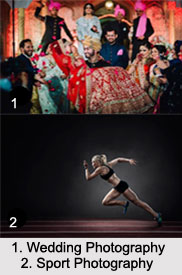 • Black and White photography: It is also called 'Monochrome' photography. It produces images which are containing tones of grey ranging from black to white. Monochrome photography is chiefly used for artistic reasons. • Black and White photography: It is also called 'Monochrome' photography. It produces images which are containing tones of grey ranging from black to white. Monochrome photography is chiefly used for artistic reasons.
• Ariel Photography: These pictures show a larger sight of the subject and its setting. Typically the camera is not supported by a ground-based. • Wildlife Photography: This style of photography portrays animals in their natural environment. Wildlife photography is concerned with documenting a variety of forms of wildlife in their natural environment. • Colour Photography: Coloured photography is a type of photography which uses medium capable of reproducing colours. It required purchasing higher photography kit. • Action/Sport Photography: It is a tough genre of photography which can also comes under photojournalism. Sports photography refers to the genre of photography which covers all the types of sports. • Food photography: Food photography is a genre of photography which is used to produce eye-catching photographs of food. It is used by restaurants to catch the attention of customers to try and sell their products. • Portrait Photography: It captures the character of a subject by using useful lights, settings and poses. One of the oldest genres of clicking is portrait photography. • Macro Photography: Macro photography is extreme close-up photography, typically of very little subjects and living organisms like insects. • War photography: War photography means generally capturing images of conflicts in war-torn areas fall under this type. 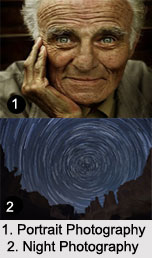 • Night Photography: Night photography is generally a type of landscape or architectural scene with some lights throughout the symphony. These types of photography require a good connect of the use of light, shutter speed and aperture. • Night Photography: Night photography is generally a type of landscape or architectural scene with some lights throughout the symphony. These types of photography require a good connect of the use of light, shutter speed and aperture.
• Architectural Photography: It is mostly used in the business part. Architectural photography is the photographing of buildings and similar structures. • Erotic/ Nude Photography: Erotic photography is a style of art photography. This kind of photography is sexually suggestive in nature. • Urban and Rural photography: This type of photography generally includes taking random incidents within public places. • Travel photography: It is a genre of photography which involves the documentation of an area's landscape, people, cultures, customs and history as well. Indian Photographers Some of the renowned Indian Photographers are Homai Vyarawalla, Raghubir Singh, Ashok Salian, Lala Deen Dayal , Raghu Rai, Vikram Bawa, Victor George, Gautam Rajyadhyaksha, Jatin Kampani, Daboo Ratnani, Sharad Haksar, Rathika Ramasamy, Swapan Mukherjee, Varun Aditya etc. Federation of Indian Photography Federation of Indian Photography was produced in 1952 with the persistent attempt of Dr. G. Thomas, Mr. B.K.Mukherjee, Mr.S.H.H.Razavi, Mr. O.C.Edwards and Mr. G.Arunachalam. Federation of Indian Photography (FIP) is the Indian national body of The International Federation of Photographic Art. The current contact officer is Barun Sinha. |
| ||||||||||||||||||||||||||||

