


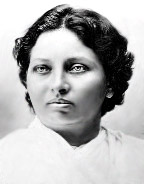
 Pandita Ramabai was one of the early pioneers in the field of woman's education and a champion of women's rights. Her upbringing was such that it was conducive to her later role as a women's right activist. The Kolkata elite were enchanted by her revolutionary and learned ways and bestowed on her the name "Saraswati" - after Goddess Saraswati of Learning - and called her "Pandita" because she seemed as learned as other Brahmin Pundits. Pandita Ramabai was one of the early pioneers in the field of woman's education and a champion of women's rights. Her upbringing was such that it was conducive to her later role as a women's right activist. The Kolkata elite were enchanted by her revolutionary and learned ways and bestowed on her the name "Saraswati" - after Goddess Saraswati of Learning - and called her "Pandita" because she seemed as learned as other Brahmin Pundits.
Early Life of Pandita Ramabai Her father, Anant Shastri Dongre, was a Sanskrit scholar with a modern mind and outlook. He father supervised her education and allowed her to remain unmarried. He personally tutored her in Puranic Sanskrit. When her father and mother died, Ramabai was sixteen years old, unmarried, and able to read Sanskrit language. She and her brother travelled throughout India lecturing on female education and social reform. Ramabai's brother died in Kolkata and she married his close friend, Bipen Behan Das Medhavi (a Shudra by caste). The next year, at age twenty-three, Ramabai gave birth to a daughter. Unfortunately her husband died the following year, and she returned to Pune. Returning to Pune, Ramabai began to work with reformers to educate women through the Arya Mahila Samaj (Aryan's Women's Society). While in Pune she gave evidence before the Hunter Education Commission and stressed the urgent need for women doctors and teachers. Determined to learn English and study medicine, Ramabai sought help from members of the Anglo-Catholic Community of St. Mary the Virgin whose Mother House was at Wantage in Oxfordshire, England. They were able to give her some assistance while the rest of her expenses were met through the sale of Stri Dharma Neeti (Morals for Women), her book urging women to take charge of their own lives. Ramabai, her young daughter, and a travelling companion, Anandibai Bhagat, left for England in 1883. Soon after the three of them had settled at Wantage, Ramabai declared she was unwilling to convert to Christianity. Some months later Anandibai committed suicide leaving Ramabai extremely shaken. Ramabai was only twenty-five years of age and had already watched her parents, her brother, her husband, and her closest friend die. It was at this time, alone with her small daughter in a strange country that Ramabai decided to accept baptism. She continued her studies until 1886 when she decided to sail for America to attend the graduation ceremonies of her cousin Anandibai Joshi. To finance this trip and popularize her cause Ramabai wrote 'The High Caste Hindu Woman.' Ten thousand copies of this book were sold before Ramabai had left America. In 1887 Boston admirers set up a Ramabai Association to support her work in India. She traveled throughout the United States and Canada studying educational, philanthropic, and charitable institutions and lecturing to various groups. By May of 1888, she had collected over 30,000 dollars in the name of her association. Pandita Ramabai's Campaign in India Sharada Sadan In India Pandita Ramabai established Sharada Sadan (Home of Wisdom), a school for widows, in Mumbai. This was to be a non-sectarian school where, however, all the caste rules of Brahmins were meticulously observed. It attracted some high-caste Hindu widows, but generally the Hindu community remained suspicious of Ramabai's motives. Ramabai tried to prevent criticism by forming an Executive Committee composed of reformers who were known as staunch Hindus. This plan did not work and less than one year later Mumbai newspapers carried articles critical of Ramabai and her school. When financial problems forced her to move the school to Pune, the newspaper Kesari charged her with converting widows to Christianity. Ramabai's admitted crime was allowing widows to attend her personal prayer meetings. By 1893 twenty-five girls were withdrawn. But there was no dearth of widows in need of shelter and before long Ramabai had other students. By 1900 the Sharada Sadan had trained eighty women who were able to earn their own living through teaching or nursing. Mukti School Ramabai's second school, Mukti, was established thirty miles outside of Pune at Kedgaon following the famine that began in 1897. She began taking women and children who were victims of famine into Sharada Sadan where she fed and clothed them, and enrolled them in her school. Attempting to control the plague, the government placed restrictions on the movement of people; in Pune the city magistrate placed a limit on the number of inmates in Sharada Sadan. Since she could not keep famine victims in Pune, Ramabai took her charges to Kedgaon where she had purchased 100 acres of land. By 1900 this venture had grown into a major institution housing 2,000 women and children attending school and involved in industrial training and production. Financing for Mukti came from an American committee which willingly approved all her schemes. Ramabai designed a remedial curriculum. Literature which was selected for its emphasis on moral models would bring about a spirit of caring; classes in physiology and botany were included to teach students about their own bodies and the physical world in which they lived. Industrial training was included in printing, carpentry, tailoring, masonry, wood-cutting, weaving and needlework, as well as training in farming and gardening. All students were required to join unions or societies such as the Temperance Union or the Christian Endeavor Society in an effort to break down caste barriers and develop new loyalties based on interest. As members of these societies, the children learned simple parliamentary rules and were encouraged to take charge of their own affairs. Philosophy of Pandita Ramabai Ramabai urged the inmates of her home to become Christians and developed a unique educational program to suit their needs. Her own version of Christianity was one comprised of assorted doctrines, and she combined ideas and she combined ideas she had learned from the sisters at Wantage, and from Roman Catholic, Jewish, and Indian Christian friends. Ramabai saw caste as the great flaw in Hindu society. It led to false valuing of the intellect and condemnation of physical work. Caste associations promoted narrow self-interest and prevented the development of a democratic spirit. The educational work of Ramabai was commendable and had greatly impressed her contemporaries. However, her connection with Christianity subdued the impact of her contribution to women's education. Her work angered a lot of prominent men in western India as she was an acknowledged Christian as was the ruling power and hatred of the latter was growing daily. Ramabai believed the intensity of their anger was related to the fact that many of her pupils came from the higher castes. She argued that these men would have remained unconcerned if her work were confined to low-caste women. In 1919, the king of England bestowed on her the Kaiser-i-Hind award, one of the highest awards that an Indian could boast of during the colonial regime. Ramabai is celebrated as a national icon of women's development movement in India. Ramabai's greatest legacy was her effort, the first in India, to educate widows and the pupils she left behind to carry on her work. |
| |||



Pandita Ramabai
| Pandita Ramabai was one of the earliest women activists. She herself was very well-educated and her efforts at female education ushered in a new chapter in the history of women’s education in India. |
| ||||||||||||||||||||||||||||

