Kabir was an important Bhakti saint. There is not much information about Kabir`s life. He influenced the Sikhism so much. Kabir`s views are are carried by the followers of Kabir who are known as Kabir Panthis.
Early life of Saint Kabir
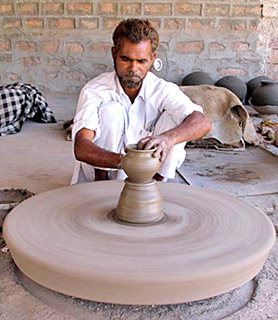
There is a controversy regarding the birth year of the saint. Some people hold that it is 1398 when other says that it is 1440. According to tradition he was the illegitimate son of a Brahmana widow. To hide her shame she threw the child in a pond called the Lahar Talao at Banaras. A Muslim weaver named Niru saw him and took pity on him and carried him to his home, where his wife brought him up with great affection and care. When he grew up he took up his father`s trade but found time to moralize and philosophise.
Kabir lived in the 15th century after Christ, which was a time of great political upheaval in India. Kabir`s life was centred on Kashi, also called Banaras (Varanasi). At that time Hindu saints started Bhakti movement, while Sufi mysticism was started by Muslim saints in medieval India (1200-1700).
Saint Kabir`s Philosophy
Kabir believes that life is an interaction of two spiritual principles. Hey are jivatma or the personal self and is the parmatma or God. According to him Salvation can be met by uniting these two spiritual aspects. According to him he was independent both of ritual and of bodily austerities. Kabir believed in sell-surrender and God`s bhakti. The Kabir panthis follow a life of singing the praises of God, prayers and a simple and pure life of devotion. Kabir recommends ceaseless singing of God`s praises.
Kabir`s Idealism
Kabir is a firm advocate of ahimsa. His doctrine extends even to the non-destruction of flowers. Among the fifty commandments laid down for the followers of Kabir, vegetarianism is one of them. For Kabir, moral life involves adherence to ahimsa. In common with all monastic, ascetic or otherworldly sects, Kabir does not think well of women. There is almost a tirade against them in the hymns of Kabir.
The moral tone is quite strong in Kabir`s hymns. "Where there is mercy, there is strength, where there is forgiveness there is He
He tried to teach Hindu-Muslim Unity. He tried for a synthesis of Islam and Hinduism by preaching communal harmony, and stressing those virtues, which were common to both religions. He was against idol worship and has an aversion for religious controversy and rituals and superstitions as well. He considered it as useless to visits to places of pilgrimage. He equally condemned the Muslim rituals and hajj to Makka. He demonstrated the Muslims for slaughter of cows and Brahmans for performing sacrifices involving slaughter of animals. He ridiculed the Muslim practice of circumcision and Brahmins for wearing the sacred thread. He also criticized the Sraddha feasts.
Kabir refused to accept caste system by birth. He refused to recognize the superiority of Brahmanas as a caste. He advocated perfect equality of Sudras and Brahmins. The main theme of Kabir`s social philosophy was that humanity is a sacred trust of the Almighty. The influence of his teachings spread to Punjab, Gujarat and Bengal and it continued to spread even under the Mughal rule. His code of Ethics was also unique. He condemned pride and selfishness. One should cultivate the quality of humility. He appreciated the simplicity of the poor and condemned the vanity and pride of the rich. By such condemnation Kabir preached the common brotherhood of man
Works of Kabir
Kabir`s poetry is steeped in Bhakti and also the religion of love. Written in the popular Hindi, the songs of Kabir are deliberately addressed to the people. Kabir composed no systematic treatise; rather his work consists of many short didactic poems, often expressed in terse vigorous language in the form of Padas, Dohas and Ramainis. Besides his work recorded in 1604 A.D., in Guru Granth Sahib by Guru Arjan Dev, Nanak V and preserved inviolate since, two other collections exist - Kabir Granthavali, and Bijak. In his poems, he was quick to tell the illustrations of moral and spiritual truth in the incidents of everyday life and many of his similes and metaphors are very striking.
In the year 1518 Kabir died at Maghar near Gorakhpur district. It is said that an argument between Hindu and Muslim arose regarding the burial of Kabir`s body where the Hindus wanted to cremate his body. Finally the problem was solved by the Saint himself appearing among the disciples. His body was transformed into fragrant flowers. Then the flowers were divided and were buried as well as cremated.