|
Indian astronomy is in practice since around 2000 B.C. The science of Indian astronomy is known as Khagola-shastra. The word Khagola was derived from the famous astronomical University of Nalanda. Indian astronomy became an established tradition by the 1st millennium BCE, when Jyotisa Vedanga and other supplementary branches of learning called Vedangas began to take shape. During the following centuries a number of Indian astronomers studied various aspects of astronomical sciences and global discourse with other cultures in combination. A number of instruments were used in Indian astronomy, which was also applied for calendrical studies.
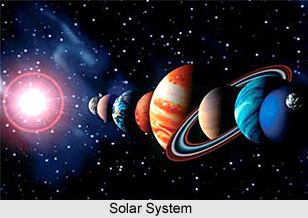 Indian astronomy in its initial ages was intertwined with religion. The first textual mention of Indian astronomical concepts comes from the Vedas. The cardinal directions of Indian astronomy are found in the Sulbasutra (1st millennium BCE), a discourse containing mathematical applications used for altar construction. Mathematics and astronomical instruments were used widely to calculate time after sunlight, daylight periods, computation of sunrise, computation of sunset, and general measurement of time. Ohashi (1993) states that Jyotissa Vedanga astronomy gained a foothold between the 6th and the 4th centuries BCE. The Pancasiddhantika (Varahimira, 505 CE) approximates the method for fortitude of the meridian direction from any three positions of the shadow using Gnomon. The religious texts of India also offered information about astronomical observation for carrying out ritual associated with religion at a certain time.
Hindus kept a pancanga for calculations of tithi (lunar day), vara (weekday), naksatra (asterism), and karan (half lunar day) for social and religious events that are closely related to Indian astrology. The divisions of the year were on the basis of religious rites and seasons (Ritu) of the Hindu calendar also provide information. Aryabhata was the author of the ?ryabhat?ya and the Aryabhatasiddhanta, which is one of the most important books of Indian astronomy. Its contents are preserved to some extent in the works of Varahamihira (flourished c. 550), Bhaskara I (flourished c. 629), Brahmagupta (598-c. 665), and others. Indian astronomy is still one of the most interesting aspects of study and practice.
|
|
|
|
|
|
|
|
Recently Updated Articles in Astrology
|
|
|
| • | Rings in Hand - Palmistry
Rings in Hand are the integral aspect of Palmistry that determines the future and even characteristics of an individual.
| | | • | Number Nine - Numerology
Mars is the ruler of the number Nine and Mars is the planet of courage, drive, aggression and masculine energy.
| | | • | Number Eight - Numerology
Number "Eight" vibrates to the planet `Saturn` Or `Shani`.
| | | • | Number Seven - Numerology
The planet `Ketu` rules number Seven. Ketu conveys energy of thoughts and philosophy.
| | | • | Number Six - Numerology
Venus rules number Six. Venus is the planet governing love, harmony, luxuries, arts and beauty.
| | |
|
|
|
|
|





