





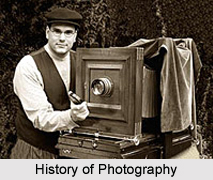
 The existence of photography in India can be traced back as early as the 16th century, when the Camera Obscura acted as a mechanism for projecting images. These early cameras did not fix an image, but only projected images from an opening in the wall of a darkened room onto a surface, turning the room into a large pinhole camera. Later experiments started and the process of photography became more technologically advanced. However, the serious influx of Photographic art arrived in India under the reawakened sway of the Colonial Powers. Despite lack of prompt transport, apparatus photography was available in India as early as 1850s. The existence of photography in India can be traced back as early as the 16th century, when the Camera Obscura acted as a mechanism for projecting images. These early cameras did not fix an image, but only projected images from an opening in the wall of a darkened room onto a surface, turning the room into a large pinhole camera. Later experiments started and the process of photography became more technologically advanced. However, the serious influx of Photographic art arrived in India under the reawakened sway of the Colonial Powers. Despite lack of prompt transport, apparatus photography was available in India as early as 1850s.
The Bombay Photographic Society was formed in 1854 with 200 members. Similar bodies were formed in Madras and Calcutta in 1856 tied to the colonial regime. The East India Company declared Photography to be the most accurate and economical means of recording the architectural and archaeological monuments for official records, travellers etc. The company actively encouraged the employees to photograph, and record archaeological sites. Thus, it was due to this that photography became a key element of the 'Archaeological Survey of India', established in 1861 (following on from the activities of the 'Asiatic Society' dating from 1784) and still in existence. Many missionaries coming from Britain to bring Christianity to India were keen and sometimes very competent amateur photographers. These few westerners in India formed the major market for photography in India being largely the ones with the money to buy photographs. During the period of 'Indian Mutiny', there was a considerable public interest about India in Britain, creating an increased market for photographs about the culture and lifestyle in India. Thus, this was a key event in the development of photography in India - as well as a milestone in the struggle for independence. People who read stories in the newspapers about Delhi or Lucknow wanted to see what these places looked like and wanted to see pictures of the Indians. Later on, in the 19th century, India was at the vanguard of photographic development and a wide range of arresting images about India had been captured the photographers, many of which had never been seen in public before. The photographs drawn from the British Library and the Howard and Jane Ricketts Collection, reflected the major preoccupations and achievements of 19th century Indian photography. They included: the early amateurs who first introduced the medium; the documentation of India’s architectural and ethnic diversity; the achievements of commercial photographers such as Samuel Bourne; and Princely India. Other themes included natural history, panoramas, trade and the industrialization of India and the Durbars. Since the 18th century people, events and landscapes in India had been keenly observed and documented by both Indo-European artistic cult in paintings, drawings, aquatints and lithographs. Within a few years of its introduction in Europe in 1839, however, photography had become the new recording medium. After which, it was no more a rocket science and photography became available for the mass-market in 1901. Since then, the colour film has become standard, as well as the automatic focus and automatic exposure cameras. And today, with the introduction of Digital cameras, the SLR, DSLR etc the digital recording of images is becoming increasingly common in India as well. |
| ||||||||||||||||||||||||||||

