


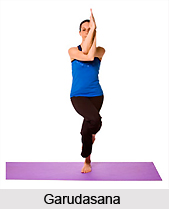
 Garudasana or the eagle pose (Garuda means Eagle in Sanskrit is one of the cultural asanas that embodies the twofold twists of the extremities in one pose. The suppleness and elasticity also indicate freedom of movement for the joints and the extremities. Garudasana involves simple body-twists, especially for the arms and the legs. Garudasana or the eagle pose (Garuda means Eagle in Sanskrit is one of the cultural asanas that embodies the twofold twists of the extremities in one pose. The suppleness and elasticity also indicate freedom of movement for the joints and the extremities. Garudasana involves simple body-twists, especially for the arms and the legs.
Yoga Texts and Garudasana Postures named Garudasana, or Khagasana (Khaga also means Eagle in Sanskrit) have been mentioned or described in various Hatha Yogic texts, starting with the Hatha Rathnavali, which describes the Khagasana as one of the 84 classic yoga asanas. The later Gheranda Samhita (1800 AD) describes the Garudasana in detail as does the Shri Tattva Nidhi (1900 AD). However, the Garudasana of the Hatha Yoga texts is a variation on Virasana and is not the contemporary body twist pose Practice of Garudasana * One must stand erect, lift one leg (the alternate use of each leg being implied) and twist the same both near the hip-joint and the knee. * Then twine it around the other leg. * He/she must adjust the twists very carefully and without strain. Then with the toes of the twisted leg lock the ankle of the other leg and hold it there as a safety against possible release. 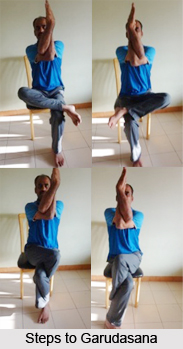 * One must do this while exhaling. When the balance on one leg is secured, one should try to keep the body straight and gradually increase the pressure of the toe-hold on the ankle till the maximum twist is attained.
* First one should practice only the leg, twist during the retention of breath, for a week or so. * When this is well secured, then the person should try the arm and hand-twists by twining one arm around the other (alternating the arm with each movement). * Likewise one must twist the hands also from the wrists and join the palms against each other. * The practitioner should maintain the pose for some time and while inhaling, return to the starting position. * The movements, breathing and time should be adjusted accordingly: (i) After body-twists, one should slow down the forceful exhalation for 5 seconds; (ii) One should maintain the pose retention of breath for 5 seconds (alternatively, normal slow, rhythmic breathing, if maintained for longer periods not exceeding 2 minutes) (iii) While exiting, one should return to starting position and inhale for 5 seconds. This should be repeated alternately three times on each side. Effects of Garudasana The posture of Garudasana helps to loosen the joints by flexing and stretching the tendons and muscles of the shoulders, elbows, hips, knees and ankles. When practised regularly, Garudasana encourages suppleness of the arms and legs through specific exercise of the tendons and ligaments thereof, thus ensuring complete freedom of movements for the various joints. One must avoid strain while twisting and practise and thus perfect it by stages. Flexors, abductors and internal rotators of the hip, plantar flexors of the ankle, protractors of shoulder girdle, flexors abductors and medial rotators of the shoulder and flexors of the elbow are exercised in this asana. Posterior aspect of scapula and posterio-lateral aspect of shoulder are stretched. Co-ordination of muscular activity is brought about by this Asana. |
| |||



Garudasana Yoga Asana
| Garudasana or the eagle-pose is a cultural asana named involving a twofold twist of the extremities, and enables great freedom and flexibility in the extremities with regular practice. |
| ||||||||||||||||||||||||||||

