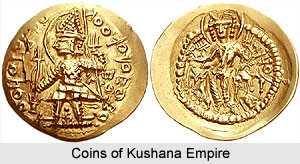
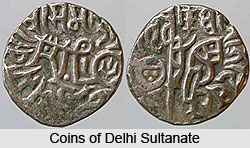
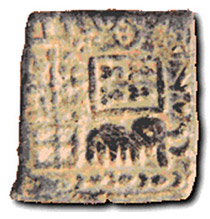
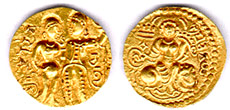
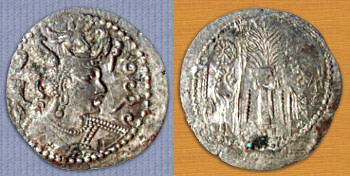
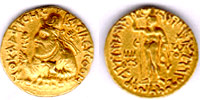
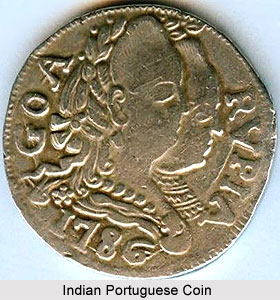
 The coins of ancient India, both in the north and the south, and of the indigenous states and the foreign invaders as well as of the foreign invaders had pictorial or heraldic devices. After the coming of Muslims in India, a new pattern was introduced in the Indian coinage. The ancient style of coins was removed and a new style was introduced. The Islamic coins carried the name of the rulers which were of special importance. The crusading zeal of the early Khalifas of Syria in the eighth century A.D. had introduced the `Kalima` and later this formed part of the Muslim coins.
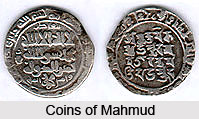
The end of the 8th century marked the arrival of Islams in India. It was in 10th century AD, the second Islamic invasion of India took place, carried by Mahmud of Ghazni. Mahmud invaded India 17 times, mainly for the acquisition of `wealth of Hindustan`. He took control of Punjab and later plundered the rich city of central India and capital of many of Coins of Mahmud the post-Gupta dynasties, Kanyakubj (modern Kannauj). His silver coins were special in Indian numismatics as they had his name written on coins in two different languages. On obverse the legends were in Arabic but on the reverse side legends were inscribed in Sanskrit, written in Devanagri script. The legend on reverse had Avyaktamekam Muhammad Avatar Nrupati Mahmud in center and around it; the legends had Avyaktiya Name Ayam Tankam Hato Mahmudpur Sanvanto 418. The earliest Muslim kingdom in India was set up by Imad-ud-din ibn Qasim in Sindh and his governors issued some tiny coins of base silver on the pattern of the Khalifas.
Muhammad bin Sam, popularly known as Muhammad Ghori, struck gold coins in imitation of the coins that were then current in the country. Muhammad bin Sam went even further than his Ghaznavid predecessors when he struck gold coins bearing on one side the Hindu goddess Lakshmi and on the other his name in Nagari script. Two very interesting coins, both inspired again by the traditional "Bull and horseman" type. They were exceptional because the first woman who ever ruled India struck them. This particular type of coin retained the name of Samantadeva in Nagari. The general of Muhammad bin Sam, Muhammad bin Bakhtiyar Khilji, issued gold coins in his master`s name to commemorate his own conquest of Gaur. After Muhammad bin Sam, some billon and copper coins were issued by Mahmud, the son of his elder brother and Tajuddin Yildiz. It had been said that the names of the coins were issued by the local governors.
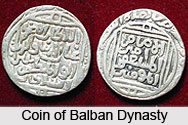
After the enthronement of Qutubuddin Aibak, he initiated to issue some coins but he did not issue any coin bearing his name. The next ruler Iltutmish issued silver coins with various legends. Some of the coins bore the `Kalima`. The variation followed in the time of Iltutmish was adopted by the seven succeeding Sultans. Some gold and silver coins, similar to the gold horseman type coins of Muhammad bin Sam, were also issued in the name of Iltutmish from Bengal. Moreover, Iltutmish issued three types of coins in billon. Among the coins, one type of coins had a bull on the obverse side and a horseman on the reverse side of the coin. These coins fall into different groups according to the inscriptions. The most common coins were the type which had `Suritana Sri Samasadin` on the bull side and the name of `Khalifa.` Among the three types of coins, the third type of coin bore an Arabic legend on one side and a Nagari legend with the `Vikrama samvat` on the flip side of the coin. The third type of coins was not accepted by his successors but they issued first two types of coins. Later this series were abandoned by Balban and he discarded the pictorial devices from the coins. He issued the coins with his name in Arabic in a circle with a Nagari legend. Even the copper coins of all the rulers bore the legends on both sides. Some coins showcase the name and the title on one side and the name of the mint on the other side of the coin.
The style of the coins witnessed change in style and appearance during the ruling period of the Khiljis. The third ruler of this dynasty, Alauddin Khilji issued ample range of coins. He and his successor, Qutbuddin Mubararak Shah issued gold and silver `tankah` and coins of heavy weight. During this time, the patterns of the coins were changed and the rulers of Khilji dynasty introduced new pattern in the coins. Alauddin Khilji changed the pattern of the inscription of the coin by dropping the name of the Khalifa from the obverse side of the coins. Firoz Khilji and Alauddin Khilji retained the bilingual reverse on their billon coins, introduced by Balban. So many patterns of coins were introduced by the rulers this time. Qutbuddin Mubarak added a few more types of coins to it. The copper coins of the early Sultans of Delhi were smaller in value than the billon `gani`. Some of the coins that were issued during this particular time bore the names of the places where they were coined.
The third dynasty of the Delhi Sultans was the Tughlaqs. The first ruler of this Tughlaqs dynasty, Ghiyasuddin Tughlaq, followed the pattern developed by the Khilji coinage. The rulers of this dynasty issued coins from all the metals like gold, silver, billon and copper. The great ruler of Tughlaq dynasty, Muhammad bin Tughlaq surpassed his predecessors in execution of coins, especially in the matter of calligraphy. He paid serious attention to the reform of his coinage and established several mints in various cities of his kingdom. His experiments with his coinage, particularly his forced currency, give him a prominent place among the greatest moneyers of history. He has been called the "the prince of moneyers". Expansion of the mint system was one of the outstanding features of his coinage. The earliest and most curious coins of the second ruler Muhammad Tughlaq were those that he had struck bearing the name of his father.
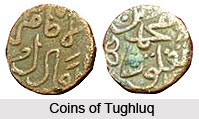 The inscriptions on some of these mention their various denominations. He struck a new coin of 140 ratis and called it `adli`. This remained the standard denomination throughout his reign. He also divided the `tankah` into several parts, the `du-kani`, `shash kani`, `hasht kani`, `dwazda kani`, etc. Later in the ruling period of Muhammad Tughlaq, `Kalima` was introduced on the coins and this was discarded from the coins after Iltutmish. Muhammad brought in a new pattern by attempting to issue token coins of copper in place of the silver and billon `tankahs`. There were twenty five variations of Muhammad`s billon coins which had been of two distinct standards. Even in the later period, Firoz Tughlaq followed the example of his predecessor and inscribed the name of the `Khalifa Abdul Abbas` and of his two successors Abdul Fateh and Abdullah on the obverse side of the coin.
The splitting of the empire of Muhammad bin Tughluq led also to the creation in 1403 A.D. of the Gujarat sultanate. The coins of this sultanate were struck following a metrology with two parallel standards known as the "Gujarat standard" and the "Delhi standard", probably to facilitate trade between the Gujarati ports and the then territorial dominion of Delhi sultanate. The famous coins called `dehiwals` with the humped bull and the king`s name in Nagri characters on the reverse and the Chauhan horseman on the obverse were minted copiously by almost every sultan until the reign of Alauddin Masud (1241-46), who discontinued this type. After the Tughlaqs, the kingdom of Delhi was passed into the hands of Bahlol Lodi in 1451.Since the issue of the silver and the gold coins had dwindled to a small number by then, Bahlol Lodi decided to eliminate them altogether. He had chosen to stick to the billon and copper currency.
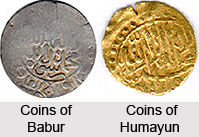
In 1526, Babar, who founded the dynasty of the great Mughals, defeated the last Lodhi king, Ibrahim. The coins of Babur and Humayun, especially the silver `shahrukhis` followed the Timurid devices and were struck at Lahore, Delhi, Agra and Kabul. On the obverse of these coins is the `Kalima` with the names of the four orthodox caliphs and their attributes in the margins. On the reverse is the king`s name in the area, together with various titles and the name of the mint and the date.
Sher Shah, the founder of the Suri dynasty who defeated Humayun in 1540 and ruled the country for about five years, is credited with introducing a reformed currency. He abolished the inconvenient bullion coinage of mixed metals and struck well-executed pieces in gold, silver and copper, with a fixed standard of weight. He issued silver and copper coins in his own name from a number of places. After his formal coronation, he eliminated the mixed metal (billon) coinage once and for all from the series of Indian coins. His silver rupees have a standard weight of 178 grains, while copper dams weighed 330 grains. He also standardized the sub-division of the rupee and the dam. The coins, especially the silver pieces, bore the usual Arabic inscriptions as well as the name of the king in the Nagari script. Sher Shah also established a number of new mints in his kingdom. The silver coins of Sher Shah bore the `Kalima` and the names of four `Khalifas` on the obverse side of the coin and the reverse side of the coin included his name, the pious wish `Khald Allah mulk`, the mint name and date along with the king`s name `Sri Sersahi` in Nagari letters. The coins were issued from different mints.
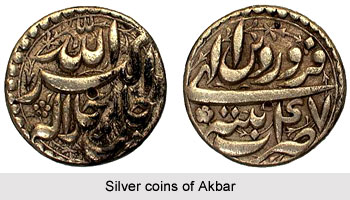
With Akbar`s succession in 1556 a new era of coinage began in the subcontinent. Akbar established a separate department and appointed a mint master at the capital to control the minting of coins. The first master of the mint was Khwaja Abdus Samad who was an eminent painter and calligrapher. The early issues of his reign closely follow the model and scheme of Sher Shah`s coins. The Ilahi coins of Akbar are the most interesting series. These depict the religious and social changes in Akbar`s policy. He used the coinage to express his views about the "divine religion." The Ilahi coins issued from Lahore were some of the finest of the Mughal series. The coins bear entirely new legends and are inscribed with the Islamic verse "Allahu Akbar Jalla Jalaohu." Akbar also started the innovation of using Persian couplets on his coins, which indicate his name or the mint and date.
Jahangir primarily maintained his father`s mint system. His gold and silver coins are the most ornate of all the Mughal series.
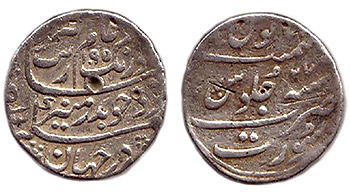
 The coins of his time were mainly issued from Lahore, Agra and Surat; the coins bear the name of the Queen along with that of Jahangir in the usual Persian couplets. Jahangir`s most celebrated `muhars` display his portrait. In the 13th year, he issued the beautiful series of zodiac `muhars` on which pictorial representations of the zodiac symbol were substituted for the name of the month. The coins of Aurangzeb (1658-1707) and his successors have, with few exceptions, no novelty, except that the emperor discontinued the `Kalima` on his coins, and dates were given in Hijri years. During the later period, pretentious personal titles were frequently shown on the coins. The downfall of the Mughal Empire brought chaos in the coinage.
With the end of the ancient era, the new pattern of medieval era was introduced. In the medieval era, the patterns of the ancient era were not delineated much. The gradual development of the eras and the rulers introduced different styles and usage of metals in making coins. With the commencement of the British period, the paper currency was introduced and a huge change in the monetary system was made.