|
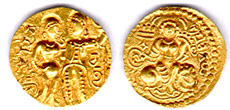 Gupta, an empire and dynasty of northern India, was lasted from about A.D. 320 to 480. The dynasty was founded by Chandragupta I., who must not be confounded with his famous predecessor Chandragupta Maurya. He gave his name to the Gupta era, which continued in use for several centuries, dating from the 26th of February, A.D. 320. Chandragupta was succeeded by Samudragupta (c. A.D. 326-375), one of the greatest of Indian kings, who conquered nearly the whole of India, and whose alliances extended from the Oxus to Ceylon; but his name was at one time entirely lost to history, and has only been recovered of recent years from coins and inscriptions. Gupta, an empire and dynasty of northern India, was lasted from about A.D. 320 to 480. The dynasty was founded by Chandragupta I., who must not be confounded with his famous predecessor Chandragupta Maurya. He gave his name to the Gupta era, which continued in use for several centuries, dating from the 26th of February, A.D. 320. Chandragupta was succeeded by Samudragupta (c. A.D. 326-375), one of the greatest of Indian kings, who conquered nearly the whole of India, and whose alliances extended from the Oxus to Ceylon; but his name was at one time entirely lost to history, and has only been recovered of recent years from coins and inscriptions.
The main purpose behind the choice of Gupta coin designs seems to have been one of political propaganda. The king is always shown in ways that emphasize his status as a great ruler and heroic warrior king. The representations are idealized images that adhere to the strict contemporary artistic concepts of the perfect human form.
The Gupta coinage started with a remarkable series in gold issued by Chandragupta I, the third ruler of the dynasty, who issued a single type- the king and queen - depicting the portraits of Chandragupta and his queen Kumaradevi with their names on the obverse and the goddess seated on a lion with the legend Lichchhavyah on the reverse.
It is very likely that their illustrious son, Samudragupta, minted these coins. Though this is highly debatable. There is a coin where Chandragupta and Kumardevi are shown (without halo). Chandragupta is offering a ring (or putting Sindur) to his queen Kumardevi. Chandra in Brahmi script is written below left arm of King while Shri-Kumardevi is written near right hand of queen. Reverse of coin shows goddess Ambika, sitting on Lion. The legend on reverse reads Lichchavyah, which suggests that indeed, Samudragupta took pride in being son of Lichchavi princess. His affection towards his parents is amply demonstrated while issuing this superb gold coin. This coin is a rare and very special in Indian numismatics.
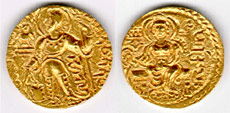 The coins of Samudragupta give us a lot of information on the start of the mighty empire of Guptas, and its economy. Samudragupta issued, as many as 8 different types of coins for himself. They are known in numismatic terms as Standard, Archer, Battle Axe, Chandragupta-I, Kacha, Tiger, Lyrist and Asvamedha type. They are indicative of the conquests of Samudragupta and his attainment of paramount power. Of these Standard, Archer and Ashvamedha are known to be from Bengal. The standard type discovered from Bangladesh, Midnapore, Burdwan, HUGHLI and 24-Parganas (North) depict the standing king holding a standard and offering oblations on a fire-altar. The reverse show a goddess seated on a throne holding a cornucopia and the legend Parakramah. The Archer type, found from 24-Parganas (North), depicts the king standing, holding a bow and arrow with Samudra written under his left arm. The reverse is the same as on the standard type except the legend, which reads Apratirathah ie 'matchless warrior'. The Ashvamedha type, discovered in the Comilla district, shows an uncaparisoned horse in front of a sacrificial post with a flowing banner. The reverse shows a female (probably the chief queen) standing in front of an ornamental spear (suchi) with a flywhisk over her right shoulder and the legend shvamedhaparakramah. The coins of Samudragupta give us a lot of information on the start of the mighty empire of Guptas, and its economy. Samudragupta issued, as many as 8 different types of coins for himself. They are known in numismatic terms as Standard, Archer, Battle Axe, Chandragupta-I, Kacha, Tiger, Lyrist and Asvamedha type. They are indicative of the conquests of Samudragupta and his attainment of paramount power. Of these Standard, Archer and Ashvamedha are known to be from Bengal. The standard type discovered from Bangladesh, Midnapore, Burdwan, HUGHLI and 24-Parganas (North) depict the standing king holding a standard and offering oblations on a fire-altar. The reverse show a goddess seated on a throne holding a cornucopia and the legend Parakramah. The Archer type, found from 24-Parganas (North), depicts the king standing, holding a bow and arrow with Samudra written under his left arm. The reverse is the same as on the standard type except the legend, which reads Apratirathah ie 'matchless warrior'. The Ashvamedha type, discovered in the Comilla district, shows an uncaparisoned horse in front of a sacrificial post with a flowing banner. The reverse shows a female (probably the chief queen) standing in front of an ornamental spear (suchi) with a flywhisk over her right shoulder and the legend shvamedhaparakramah. 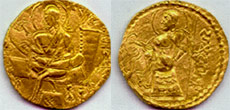 Standard types coins are numerous and common, the legend on them reads, "The unconquered one whose victory extends over a century of battles having conquered his enemies, wins heaven". The Archer type reads, "Wielding the axe of Kritant, the unconquered conqueror of unconquered kings is victorious". On the obverse, the king is shown in standing pose with royal costumes and axe of Kritant in one hand. The reverse is usual Kushan Goddess, a seated Lakshmi but not on the usual Kushan throne, but on lotus (Padma). Chandragupta-I is unique compared to the traditional Kushan coinage. In the obverse, Chandragupta-I is seen standing, but with right hand offering a ring to Kumaradevi. Legend Chandra Kramaditya is seen on them. The reverse shows Durga on Lion. On the tiger type, the king is shown trampling on a tiger, which orients backwards as King shoots with a bow. The obverse legend reads "Vyagraparakramah". The Lyrist type coins show the king in a high backed couch, playing Vina, which rests on his knees. Standard types coins are numerous and common, the legend on them reads, "The unconquered one whose victory extends over a century of battles having conquered his enemies, wins heaven". The Archer type reads, "Wielding the axe of Kritant, the unconquered conqueror of unconquered kings is victorious". On the obverse, the king is shown in standing pose with royal costumes and axe of Kritant in one hand. The reverse is usual Kushan Goddess, a seated Lakshmi but not on the usual Kushan throne, but on lotus (Padma). Chandragupta-I is unique compared to the traditional Kushan coinage. In the obverse, Chandragupta-I is seen standing, but with right hand offering a ring to Kumaradevi. Legend Chandra Kramaditya is seen on them. The reverse shows Durga on Lion. On the tiger type, the king is shown trampling on a tiger, which orients backwards as King shoots with a bow. The obverse legend reads "Vyagraparakramah". The Lyrist type coins show the king in a high backed couch, playing Vina, which rests on his knees. 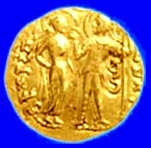 Thelegend "Maharajadhiraja - Sri Samudragupta" decorates the obverse. On the reverse is shown Goddess Saraswathi. Asvamedha types are unique; we find a horse standing before a sacrificial post from which pennons fly over its back. Samudragupta coinage features distinct Indian culture, dress, weapons, Goddesses compared to the earlier Kushan coinage. The Indianisation of Samudra's coinage is marked by close fitting cap instead of conical Kushan headdress, dhoti in place of Kushan long coat, jewelry, and Goddess Lakshmi, Durga, and Saraswati. Weapons such as battle-axe, bow, arrow and swords appear for the first time. The Copper coins found at Besnagar have the name "RamaGupta" on the obverse. Thelegend "Maharajadhiraja - Sri Samudragupta" decorates the obverse. On the reverse is shown Goddess Saraswathi. Asvamedha types are unique; we find a horse standing before a sacrificial post from which pennons fly over its back. Samudragupta coinage features distinct Indian culture, dress, weapons, Goddesses compared to the earlier Kushan coinage. The Indianisation of Samudra's coinage is marked by close fitting cap instead of conical Kushan headdress, dhoti in place of Kushan long coat, jewelry, and Goddess Lakshmi, Durga, and Saraswati. Weapons such as battle-axe, bow, arrow and swords appear for the first time. The Copper coins found at Besnagar have the name "RamaGupta" on the obverse.
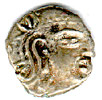
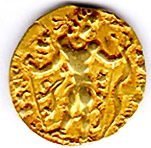 Vikramaditya or Chandragupta-II issued many types of coins - viq., Archer, Couch, Chhatra, Lion Slayer, Horse Man etc., but only two types of coins of Chandragupta II, are known from Bengal. His Archer type coins, which became the most popular type of coinage with the Gupta rulers after Kumaragupta I, have been found in Faridpur, Bogra, Jessore and Comilla districts of Bangladesh and Kalighat (Calcutta), Hughli, Burdwan, 24-Parganas (North) and Murshidabad of West Bengal. This type has two classes (one with an enthroned goddess and the other with a goddess seated on lotus on reverse) with several varieties. His Chhatra (Umbrella) type depicting a king offering incense on an altar while an attendant holds an umbrella over him on obverse and a goddess standing on lotus on reverse is known from the single specimen discovered from Hughli district. His Lion-slayer, Horseman, Couch, Standard, Chakravikrama and King and Queen on Couch types have not been found in Bengal. Chandragupta-II issued even silver coins, probably for the region that was conquered from the Western Kshatrapas. Vikramaditya or Chandragupta-II issued many types of coins - viq., Archer, Couch, Chhatra, Lion Slayer, Horse Man etc., but only two types of coins of Chandragupta II, are known from Bengal. His Archer type coins, which became the most popular type of coinage with the Gupta rulers after Kumaragupta I, have been found in Faridpur, Bogra, Jessore and Comilla districts of Bangladesh and Kalighat (Calcutta), Hughli, Burdwan, 24-Parganas (North) and Murshidabad of West Bengal. This type has two classes (one with an enthroned goddess and the other with a goddess seated on lotus on reverse) with several varieties. His Chhatra (Umbrella) type depicting a king offering incense on an altar while an attendant holds an umbrella over him on obverse and a goddess standing on lotus on reverse is known from the single specimen discovered from Hughli district. His Lion-slayer, Horseman, Couch, Standard, Chakravikrama and King and Queen on Couch types have not been found in Bengal. Chandragupta-II issued even silver coins, probably for the region that was conquered from the Western Kshatrapas.
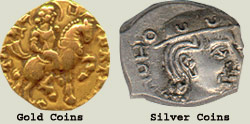 Kumaragupta-I issued various types of coins, viz., Archer, Swordsman, Asvamedha, Horseman, Lion Slayer, Tiger Slayer, Peacock, Pratapa and elephant rider type. Kumargupta also minted fine silver coins during his long reign. The Gold Dinara coin, weighing ~8.3 grams, of Kumaragupta-I, translates 'Victorious by his own merit is Mahendrakumara'. Mahendra is the son of the Hindu god Indra (the ruler of the heavens). Part of the king's owns name, Kumara, is itself an alternative name for the god of war, Skanda, also known as Karttikeya. The coin designs take this imagery further. On the back of the coin, Karttikeya is shown seated on his mount, the peacock, making an offering at an altar. On the front, the king, who is thus linked, not only by his name but also by his actions, with the god of war, is feeding the peacock. Kumaragupta-I issued various types of coins, viz., Archer, Swordsman, Asvamedha, Horseman, Lion Slayer, Tiger Slayer, Peacock, Pratapa and elephant rider type. Kumargupta also minted fine silver coins during his long reign. The Gold Dinara coin, weighing ~8.3 grams, of Kumaragupta-I, translates 'Victorious by his own merit is Mahendrakumara'. Mahendra is the son of the Hindu god Indra (the ruler of the heavens). Part of the king's owns name, Kumara, is itself an alternative name for the god of war, Skanda, also known as Karttikeya. The coin designs take this imagery further. On the back of the coin, Karttikeya is shown seated on his mount, the peacock, making an offering at an altar. On the front, the king, who is thus linked, not only by his name but also by his actions, with the god of war, is feeding the peacock.
 Skanda Gupta issued three types of gold coins, viz., archer, King and Lakshmi, and Hors Man type. As a lower denomination, he circulated debased silver coins. After the Huna war, even the gold coins were debased with silver. His successors Purugupta, Kumaragupta-II issued only one type of gold coins namely Archer type. Budha Gupta's coins followed his predecessor's type but artistic degree is not that great.
Some silver coins of Chandragupta II, Kumaragupta I and Skandagupta were discovered at Muhammadpur near Jessore in 1852. Skanda Gupta issued three types of gold coins, viz., archer, King and Lakshmi, and Hors Man type. As a lower denomination, he circulated debased silver coins. After the Huna war, even the gold coins were debased with silver. His successors Purugupta, Kumaragupta-II issued only one type of gold coins namely Archer type. Budha Gupta's coins followed his predecessor's type but artistic degree is not that great.
Some silver coins of Chandragupta II, Kumaragupta I and Skandagupta were discovered at Muhammadpur near Jessore in 1852.
|





