Bhagavad Gita, or the Lord`s Song, is the greatest legendary text of the Hindus. It is in fact the holy book of Hinduism. Though it is the sacred book of the Bhagavatas, a Vaishnavite sect, it is a book of devotion and edification for every Hindu; to whatever sect he may belong. The Bhagavad Gita is also considered as one of the most substantial Sanskrit scriptural texts and religious classic over the world. The Gita constitutes a part of the Mahabharata and is treasured especially by the followers of Lord Krishna and is largely taken from the Bhishma Parva of the Mahabharata epic. There are many Hindus today who know the whole poem from memory. Countless are the manuscripts of it which have been preserved. And since it was printed for the first time in the year 1809 in Kolkata hardly a year elapses without a new reprint of the work appearing in India. Countless also are the translations into modern Indian languages.
Background of Bhagavad Gita
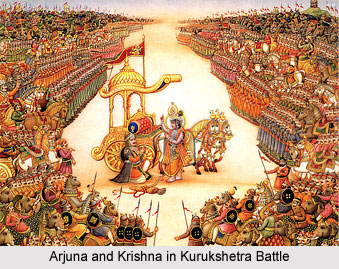
The poem is to be found at the beginning of Book VI, where the descriptions of the great fight commence. All preparations for the battle have been made. The two armies confront each other ready for the fray. Then Arjuna lets his war-chariot halt between the two armies and surveys the hosts of the Kauravas and Pandavas armed for the fight. And as he sees on both sides "fathers and grandfathers, teachers, uncles and brothers, sons and grandsons, friends, fathers-in-law and companions," he is overcome by a feeling of deepest pity. Horror seizes him at the thought that he is to fight against relatives and friends; it appears to him sin and madness to intend to murder those for whose very sake one otherwise goes to war. When Krishna reproaches him with weakness and soft-heartedness Arjuna declares that he is quite at a loss, that he does not know whether it is better to be victorious or to be defeated, and finally he implores Krishna to instruct him as to what he should really do in this conflict of duties. Thereupon Krishna answers him with a detailed philosophical discourse, whose immediate purpose is to convince Arjuna that it is his duty as a warrior to fight, whatever the consequences may be.
Composition of Bhagavad Gita
The date of composition of the text of Bhagavad Gita is not known with certainty, but it is believed to have been written around 150 B.C. The Gita contains 700 verses in 18 chapters. Krishna, the speaker of Bhagavad Gita, is looked upon as the Almighty, the Supreme Being himself. The Gita is penned down in the form of a dialogue between Krishna and Arjuna, taking place on the battlefield of Kurukshetra, just prior to the start of a climatic war.
 Content of Bhagavad Gita
The Bhagavad Gita recounts how Arjuna, the third amongst the Pandava princes, suffers from huge qualms and vulnerabilities about whether he should at all fight his cousins, the Kauravas, together with his masters and revered elders. Krishna, speaking with the authority of Lord Vishnu, persuades him that his action is just, that he is destined to complete his work here in the physical world, only to become one with Divinity. There is no cause for mourning over the imminent murder, for man himself, i.e. the spirit, is eternal and indestructible; it is only the bodies which are destroyed. And from this he leads on to exhort Arjuna to go forth into the righteous war in the spirit of his duty as a warrior. It is then that Arjuna`s military skill becomes a determinant factor in the ensuing Pandava victory. It considers the nature of God and ultimate reality and provides three disciplines for transcending the boundaries of this material world.
All the other expositions of the Bhagavad Gita upon the ethics of action culminate in the doctrine that man should, act according to his duty, but without any consideration for success or failure, and without any concerns about the possible reward. For it is only such desire-less action which is to a certain extent compatible with the real ethical ideal which consists in the giving-up of all works, in non-action, in complete renunciation of the world.
This is therefore the sacred text of the Hindus, the Bhagavad Gita. The teachings of the Bhagavad Gita are fundamental to Hinduism.