


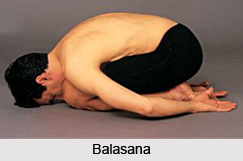
 Balasana is a cultural asana that smoothly heals the body and mind. Bala in literal sense means 'child'. Hence, this asana is also known as the 'child pose'. Balasana is a relaxing pose that can be sequenced between more taxing asanas. It relieves the exhaustion of both mind and body, supporting deep breath like that of a child. Balasana is a cultural asana that smoothly heals the body and mind. Bala in literal sense means 'child'. Hence, this asana is also known as the 'child pose'. Balasana is a relaxing pose that can be sequenced between more taxing asanas. It relieves the exhaustion of both mind and body, supporting deep breath like that of a child.
In Balasana, the body faces the floor in a fetal position. The knees and hips are bent and the chest can rest either on the knees or the knees can be spread to about the width of a yoga mat, allowing the chest that should go between the knees. The head is stretched forward toward the ground and the forehead may touch the ground. The arms may be stretched forward in front of the head or backwards towards the feet. The pose can become active through breath. Many yoga instructors recommend using this pose to substitute this pose for 'Downward Dog' posture during a sun salutation. It is usually practiced before and after Sirsasana or Headstand. Yoga Texts and Balasana The free pose "Balasana" is regarded by some authorities as a variation, of the Siddhasana, while Gheranda Samhita and others confirm it as a meditative posture independent in its technique from others. Muktasana differs from Balasana by its peculiar arrangement of legs, arms and fingers. Practice of Balasana 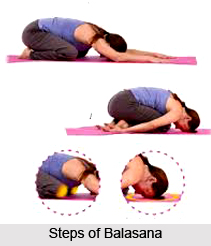 * One should touch his/her big toes together and sit on the heels, then separate the knees about as wide as the hips.
* He/she should then exhale and lay the torso down between the thighs. * Next, the person should broaden the sacrum across the back of the pelvis and narrow the hip points toward the navel, so that they nuzzle down onto the inner thighs. * One should lengthen the tailbone away from the back of the pelvis while the person lifts the base of the skull away from the back of the neck. * The person should lay the hands on the floor alongside the torso, palms up, and release the fronts of the shoulders toward the floor. * Then he/she should feel how the weight of the front shoulders pulls the shoulder blades wide across the back. Beginners can also use Balasana to experience a deep forward bend, where the torso rests on the thighs. The person should stay in the pose from 1 to 3 minutes. To exit, the person should first lengthen the front torso, and then with an inhalation lift from the tailbone as it presses down and into the pelvis. If the practitioner has difficulty while sitting on the heels in this pose, it is recommended to place a thickly folded blanket between the back thighs and calves. 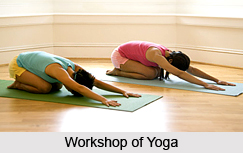 There are ample benefits of Balasana. The asana gently stretches and tones the hips, thighs, and ankle; also calms the brain and helps relieve stress and fatigue. Balasana relieves back and neck pain when done with head and torso supported. To increase the length of the torso, it is best to stretch the arms forward. The person may lift the buttocks just slightly away from the heels to get better results. Balasana should be avoided, if the person is suffering from diarrhea and if the woman is pregnant. In case of knee injury, one has to take the supervision of an experienced teacher before practicing Balasana.
Since Balasana is a resting pose, one may practice this anywhere from 30 seconds to a few minutes. Beginners can also use Balasana to experience the deep forward bend, where the torso rests on the thighs. The practitioner should stay in the pose from 1 to 3 minutes. |
| |||



Balasana Yoga Asana
| Balasana or the `child pose` is a restful cultural asana that is often sequenced between the stressful asanas. It relaxes both the body and mind. |
| ||||||||||||||||||||||||||||

