


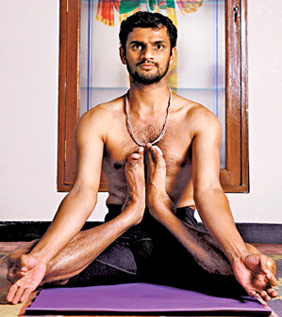
 Astanga Yoga is a system of Yoga that was taught by the sage Vamana Rishi in the Yoga Korunta, which is an ancient manuscript "said to contain lists of many different groupings of asanas, as well as highly original teachings on Vinyasa, Drishti, Bandhas, Mudras and Philosophy". This text was imparted to Sri T. Krishnamacharya in the early 1900's by his Guru Rama Mohan Brahmachari, and was later passed down to Pattabhi Jois during the duration of his studies with Krishnamacharya, beginning in 1927. Since 1948, Pattabhi Jois has been teaching Ashtanga Yoga from his yoga shala, the Astanga Yoga Research Institute. Astanga Yoga is a system of Yoga that was taught by the sage Vamana Rishi in the Yoga Korunta, which is an ancient manuscript "said to contain lists of many different groupings of asanas, as well as highly original teachings on Vinyasa, Drishti, Bandhas, Mudras and Philosophy". This text was imparted to Sri T. Krishnamacharya in the early 1900's by his Guru Rama Mohan Brahmachari, and was later passed down to Pattabhi Jois during the duration of his studies with Krishnamacharya, beginning in 1927. Since 1948, Pattabhi Jois has been teaching Ashtanga Yoga from his yoga shala, the Astanga Yoga Research Institute.
Astanga Yoga literally means the "eight-limbed yoga," as outlined by the sage Patanjali in the Yoga Sutras. According to Patanjali, the path of internal purification for revealing the Universal Self consists of the following eight spiritual practices: 1.Yamas (Principles or moral code) Yama means restraints There are five yamas viz. Ahimsa, Satya, Asteya, Brahmacharaya and Aparigraha. Ahimsa : Ahimsa is the foundation upon which the rest of the Yamas and Niyamas are based. One must have Ahimsa in one's thoughts, speech and actions. Satya : Truth must always co-relate with the facts as they are. Truth that causes pain or injury is not positive. Truth should be spoken in harmony with nature. Asteya : One must not take away from another. It would deprive others from the fruits of their work or from what is rightfully theirs. Thus stealing cause injury as well. Brahmacharya : Control of sex organs / instincts increases one's energy. From this energy one can gain miraculous powers, or more important - can gain knowledge. Aparigraha : Non - conveotusness is the lack of desire to possess not only material objects, but persons, places, feelings and so forth. The One who has no interest or desire to possess the past, present or future, will find knowledge of these three : time states coming to him naturally. 2. Niyamas (Self-Purification and study) Niyam means observances . There are five niayamas viz. Saucha, Santosh, Tapa, Swa - adhyay and Ishwar Pranidhan Saucha : Physical and mental cleanliness. Santosh : Contentment with what one has. Tapa : By fortitude the removal of impurities and mastering of the body and the senses follow. Swadhyaya : Through self study, communication can be established with the desired spiritual entity. Ishwar Pranidhan : " Our intelligence is no match to the divine wisdom". Keeping this in mind always, one should surrender to the will of God with complete faith after having done one's duties very well. 3. Asana - (Yoga Postures / positions) Asana means postures. A stable and comfortable posture which helps attain mental equilibrium. 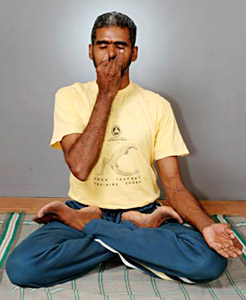 4. Pranayam : Paranayam means control of bio-energy.Prana is the vital energy which influences the functioning of each cell in the body. Control of Prana is control of mind. Vibrations of prana produce thoughts in the mind and it is Prana that moves the mind. With Pranayam, we understand and control our bio energy : the life giving force. 4. Pranayam : Paranayam means control of bio-energy.Prana is the vital energy which influences the functioning of each cell in the body. Control of Prana is control of mind. Vibrations of prana produce thoughts in the mind and it is Prana that moves the mind. With Pranayam, we understand and control our bio energy : the life giving force.
5. Pratyahar : Pratyahara means abstraction of senses.The senses follow the mind as the bees follow the queen bee : they imitate the mind. Mind is steadied with Pranayams and with practise of Pranayams, one is also able to observe : Pratyahar : abstraction or withdrawal of senses from their objects. 6. Dharna : Dharna refers to concentration The charachteristics of Dharna are : a. Placing the mind on an object for a long duration. b. Gaining one pointedness. c. Keeping the mind in a limited area. Through longer periods of sustained concentraion the mind undergoes a change, it relaxes, overcomes distractions and may poosibly help to prevent mental diseases yet to come. The mind then becomes serene and joyful. 7. Dhyana : Dhyana is meditation In Dhyana the mind does not waver from what is started in Dharna. The central aspect in Dhyanaa is the mind itself - its nature, its reaction, its steadiness or lack of steadiness. When an individual is relaxed and introspective, he understands the mind's defects. In Dhyana we see a thing from many angles and see it in its wholeness. Meditation should be of a long duration and it should be brought under our control. 8. Samadhi : Samadhi is the state of trance consciousness Bhikshu describes Samadhi as the absense of mind when concentrating on an object. In Samadhi the awareness of thinking ceases. In Samadhi - The whole effort is in realization, everything is revealed. Samadhi is an indescribable experience, if one analyses the experience while going through it, he loses it. It s an intensely positive experience, however, it cannot be intellectually explained. |
| |||



Astanga Yoga
| Astanga Yoga literally means the "eight-limbed yoga," as outlined by the sage Patanjali in the Yoga Sutras. |
| ||||||||||||||||||||||||||||

