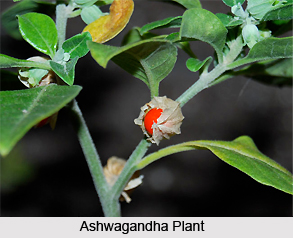
 Botanical name: Withania somniferum
Ashwagandha also known, as Indian ginseng is a low-lying shrub, perennial shrub. It is widely cultivated in the Indian subcontinent and the Middle East for its medicinal properties. It is widely found in the northwestern part of the Indian subcontinent. Ashwagandha is biologically known as Withania Somnifera. The small flowers of this pant are greenish yellow. It belongs to the family of Solanaceae or Nightshade. Ashwagandha is also known by other names like Indian ginseng, winter cherry and withania root. The history of Ashwagandha can be traced back to 4000 years. It is regarded as a very important herb in Ayurveda. Numerous studies have exhibited its anti-stress adaptogenic properties. It is becoming well known all over the globe as an herb for energy, fortitude and nervous tension. According to the Ayurvedic Medicine, Ashwagandha balances both the Nervous System and Musculo-skeletal System. In Ayurveda, Ashwagandha is also regarded as a sweet root. The distinctive earthy odor and flavor of Ashwagandha is due to the presence of certain steroidal lactones or withanolides. It is solely because of this characteristic smell that its Sanskrit name "horse`s smell" is derived. It is also possible to formulate Ashwagandha into oils, capsules and alcoholic extracts to create greater public acceptance.
Historical or traditional use
Its medicinal value is significant in the sense that it was used for tumors, leprosy, rheumatism, inflammation including arthritis and other infectious diseases. Ashwagandha gives vitality and vigor and helps in building great endurance. This herb is also believed to cure mental problems. According to a reported study this herb was given to 30 patients suffering from anxiety neurosis in two equally divided doses for one month. After the completion of the month all the ailments had disappeared. Ashwagandha also helps to undergo a regeneration of the hormonal system and heal tissues and is used for combating stress, supports healthy libido, helps to maintain a calm composure and also promotes relaxation. It also works in suppressing pains of any sort. Ashwagandha is also used very effectively for insomnia but not as a sedative. It is also known for building sexual energy. Ashwagandha is even known for strengthening the female reproductive system for which it is commonly combined with another Ayurvedic herb called `shatavari` or `asparagus racemosa`. Any athlete looking for that edge would do well to consider Ashwagandha. According to the TCM system, Ashwagandha would be used as a Kidney Yang tonic because of its warming and aphrodisiac properties. It helps in relieving from the feeling of numbness and burning sensation in extremities and also helps in improving mental ability and also in retaining power and improves mental concentration. But there is also a word of caution associated with the use of this medicinal herb. Ashwagandha may increase the effect of other herbs or medications. It is important to review with the health-care provider before taking a dose of Ashwagandha. In the recent times it is cultivated because of its great commercial demand.
Active constituents
The constituents believed to be active in Ashwagandha have been extensively studied. Compounds known as with anolides are believed to account for the multiple medicinal applications of Ashwagandha. Indeed, Ashwagandha has been called "Indian ginseng" by some. Ashwagandha and its with anolides have been extensively researched in a variety of animal studies examining effects on immune function, inflammation, and even cancer. Ashwagandha stimulates the activation of immune system cells, such as lymphocytes. It has also been shown to inhibit inflammation and improve memory in animal experiments. Taken together, these actions may support the traditional reputation of Ashwagandha as a tonic or adaptive -an herb with multiple, nonspecific actions that counteract the effects of stress and generally promote wellness.
Side Effects
No significant side effects have been reported with ashwagandha. Children in India have used the herb safely. Its safety during pregnancy and breastfeeding is unknown.