Indianetzone.com - Web Portal on Indian Culture & LifestyleArt & Culture  •  Health  •  Movies & Entertainment  •   Society  •  Reference  •   Sports  •  Travel  

  Home >> Art & Culture >> Indian Monuments >> Amer Fort
Forum
Forum on Indian Monuments
Discuss Now
Free E-magazine
Subscribe to Free E-Magazine on Indian Culture & Lifestyle.
Learn More
Interesting Readings
  - Monuments in Chennai
  - Arts in India
  - Monuments of Pattadakal
  - Churches and Convents of Goa
  - Buddhist Monuments at Sanchi
  - Indian Monuments
Jimtrade.com : India Business to Business Directory
Business Directory of Indian Suppliers Manufacturers and Products from India.
India`s leading Yellow pages directory.
Amer Fort

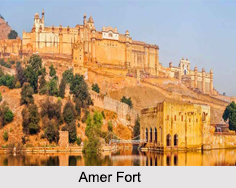
Amer FortThe Amer (Amber) fort is located at a short distance of 11 kms from Jaipur, the capital of Rajasthan State. Amber is the classic romantic Rajasthan fort palace. It also stands amidst wooded hills overlooking the Delhi-Jaipur highway, with its forbidding ramparts reflected in the still waters of the Maota Lake below. The Amer Palace is situated within the Amer Fort. One of the finest examples of Rajput architecture, the original palace was built by Raja Man Singh and additions were made later by Sawai Jai Singh. It is a classic fusion of Mughal and Hindu architecture, Built in red sand stone and white marble. It surprises the visitors with the delicate work of the artistic paradise that lies at the heart of the fort, since the latter is surrounded by the rugged and forbidding fortification walls.

Interior of Amer FortThe highlight of the fort is the Seesh Mahal, a palace known for its craftsmanship in mirrors. Even the interior wall of the palace depicts expressive painting scenes with carvings, precious stones and mirror settings. In the foreground is the Maota Lake, providing a breathtaking look. Visitors riding painted elephants can ascend to the Fort to see magnificent gateways, courtyards, pavilions, and a glittering chamber of inlaid mirrors. Painted scenes of hunting and war adorn the walls with precious stones and mirrors set into the plaster. The fort can be divided into four segments and there are two ways of reaching - one is by climbing the daunting flight of steps and the other is by riding on elephant back through the expansive passageway.

History
All the means of survival and luxuries for the royal families and the people who were concerned with the functioning of this small kingdom of the Kachhawas were well settled. The Rajputs who had apparently won a small structure passed on by Meena tribes, later on renovated it to its present status - the grand Amber Fort. Thus, Amber became the ancient capital of the Kachhwaha Rajputs until Sawai Jai Singh II moved down the hill to his newly created capital, Jaipur.

Man Singh one of the Kachhawah rulers built the Amber (Amer) fort in 1600 AD, with a delightful blend of Hindu and Mughal architecture and was finally completed by Sawai Jai Singh I in the 18th century. Thus, it took a full two centuries to build, much of it having been made in the 1500s. Holding a history as old as 7 centuries, this place vibrates with its legendry past, in the archaeological history. In the days of yore, the Amer Fort used to be a palace, an administrative headquarter as well as a strategic military bastion. Although many of the early structures have been literally ruined but at the same time, those dating from the 16th century on are remarkably preserved by sincere efforts.

An interesting past and archaeological history shrouds the fort. The Fort also has remnants of its rich past and the oldest of ruins dates back to the 16th century. The intriguing Jaleb Chowk is the central courtyard and in the days of yore the victorious royal armed forces were received and greeted here and presented their war booty to the general public.

Sites & Structures
Amer Fort CourtyardThe fort is divided in four sections and one can reach them either by climbing the imposing stairway or riding royally on an elephant on the broad aisle. The palace or the royal apartments lies inside the massive Amber fort complex with gateways, gardens, halls, stairways, pillared pavilions, temples and palaces. The fort is entered through the `Dil-e-Aaram` Garden, laid out in the traditional Mughal style. The interiors of the fort include many expressive paintings that include carvings and precious stones and mirror settings. Even the Maota Lake provides a sumptuous foreground, while the heavily structured walls of the fort, protects it against the enemies. One can also see the fountains and waterways, gardens and courtyards spread out across the rest of the fort, the ramparts of which actually weave their way into the mountains for miles around.

The main gate is known as Surajpol, which leads to Jaleb Chowk, the main courtyard. In the past, the returning armies were welcomed in the main courtyard, to display their war earnings to the population at large. The fort`s courtyard expands very wide, dominated by two buildings, of which one is the pillared red sandstone Diwan-e-Aam (the Hall of Public Audience) and the intricately painted double-storied Ganesh Pol gate, which leads to the residential apartments of the Maharaja. The Emperor`s apartments are covered with elegant frescoes and pavilions having fascinating jali screens. An imposing flight of stairs leads to the `Diwan-E-Am` (hall of public audience), which has latticed galleries and double row of columns each having a capital in the shape of elephants on the top.

Amer Fort -  carved jaalis or screensBeyond these lies a series of pillared corridors, centering on a typical Mughal `charbagh` garden, bounded on one side by Sukh Niwas and on the other by Jai Mandir or Hall of Victory has a dazzling mirror ceiling with mirror pieces on stucco and elegant inlaid panel. It is a lovely piece of architecture, which combines Rajput and Mughal features: delicate mirror work, stucco, paint and carving, one can actually look for the exquisitely carved jaalis or screens. The `Diwan- E- Khas`, hall of private audience is similar in ornamentation to Jai Mandir.

In front of the Jai Mandir is the `Sukh Niwas` (hall of pleasure) with a door made of sandalwood, inlaid with ivory with a channel running through, which formerly carried cool water acting as an air cooler. There is also the Zenana or the Women`s Palace, which has exclusive enclosures, or chambers that are linked by a general walkway. It was cleverly designed to give privacy to each queen of the Maharaja. These rooms have frescoes depicting Krishna Leela scenes surround a spectacular courtyard. There are private chambers from where the royal women could watch the proceedings of the royal court in privacy. The well-proportioned gardern, Kesar Kyari in the Center of Maotha Lake and the Dilaram Bagh at its north end provide a spectacular view of the palaces.

The fort also has a Kali Temple known as Shila Devi Temple, which is to the right of the Diwan-e-Aam. Maharaja Man Singh was a great devotee of Goddess Kali and prayed to the goddess for victory during battles. The temple has huge silver lions and silver doors with raised relief. On its doorway, there is an image of Ganesha carved from a single piece of coral. The larger white marble Shila Mata temple has the image of Goddess Kali, brought by Raja Man Singh from Jessore in East Bengal. This temple draws thousands of devotees who come here for Mother Goddess` blessings.

The Amer Fort`s resistance, though, is the exquisite Sheesh Mahal- the Mirror Palace that is liberally mirrored. Thousands of patterned mosaics, coloured glass and mirror decorate the Sheesh Mahal from floor to ceiling, creating a palace of almost unbelievable beauty.

Recently updated articles in Indian Monuments
Home | Sitemap | Contact Us
