


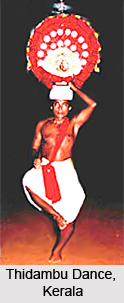
 Thidambu Dance implies the replica of an idol in a temple, which could be taken out of the holy place for certain rituals connected with the Pujas or festivals of the temples. It represents the idol of the presiding deity in that holy place. Thidambu is made of a bamboo pieces like a half circle known as 'Chattams'. These Chattams are adorned with flowers and gold and silver ornaments. The metal idol, which represents the presiding deity in the place of worship, is joined with the Chattam. This is known as Thidambu. The Brahmins perform Thidambu dance only in connection with the annual festivals of temples. Thidambu Dance implies the replica of an idol in a temple, which could be taken out of the holy place for certain rituals connected with the Pujas or festivals of the temples. It represents the idol of the presiding deity in that holy place. Thidambu is made of a bamboo pieces like a half circle known as 'Chattams'. These Chattams are adorned with flowers and gold and silver ornaments. The metal idol, which represents the presiding deity in the place of worship, is joined with the Chattam. This is known as Thidambu. The Brahmins perform Thidambu dance only in connection with the annual festivals of temples.
There are no records to know about the origin of this dance. It is said that the Brahmins who had migrated from Karnataka and Tamil Nadu during the period of Chirakka Rajas started this dance. Some of the famous Thidambu dancers of Kasaragod district are as follows Late Sri.Vethiramana Sreedharan Namboodiri of Pattena, P.T.Keshavan Embranthiri, Sree Rama Agiithaya, Thachangad, Krishna Adiga of Muttathody, Narayana Adiga, etc. this is mainly the prominent ritual art forms of northern Kerala, especially in Kasargod and Kannur district. It is staged by a group of artists in the Bhagavathy temple premises and in front of sacred Bhagavathy Kavus and shrines. This is also an integral part of 'Pooram' festival celebrated during the month of 'Meenam' i.e. during March-April. Starting from 'karthika' day to Pooram day the festival lasts for 9 days. Pooram is celebrated to praise the god of love named Kamadeva. History of Thidambu Dance According to historical accounts, Thidambu dance had come into existence over 700 years ago and follows the manner of performance which has been stated in Natyashastra composed by sage Bharatha during the second century B.C. Tulu Brahmins who had shifted to North Malabar might have introduced this dance form which was known as 'Darsana Bali'. Performance of Thidambu Dance Thidambu dancers are clad in attractive dance costumes which consist of a silk vest, a skirt made of pleated garment, bangles, earrings, a beautifully adorned turban termed as 'ushnipeetam' and necklaces. 'Pancham', 'Chambada', 'Adantha' and 'Thakiladi' are some of the various stages followed in this dance performance which is done to worship the deity. It is practised in a group. Two dancers hold the lamps while the other five dancers play percussion instruments. Drums are beaten in several rhythms, which is known as 'Kotti Urayikkal'. The Namboothiri Brahmins are generally known to perform this dance. |
| |||



Home > Art & Culture > Indian Dances > Folk Dances of Indian States > Folk Dances of Kerala > Thidambu Dance
Thidambu Dance
| Thidambu dance is a form of dance with a ritual temple art form performed only in North Malabar areas of Kerala. |
| ||||||||||||||||||||||||||||

