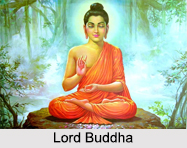
 Tantra in Buddhism was forged from a variety of metaphysical currents and religious practices within a particular socio-political context. The essence of Tantra is revealed in its etymology. In Buddhism a Tantric practitioner can cultivate an uninterrupted continuum between his ordinary initial mind, the advanced mind on the path and resultant fully enlightened mind of Lord Buddha.
Sources of Tantric Theory
Tantric theory shares much in common with the classical Indian systems. Its linguistic or metalinguistic speculations are based on those of Mimamsa. Its cosmology is modeled on the categories of Samkhya. Tantric metaphysics mostly of the non-dualistic, absolutistic type is Vedantic especially in case of Hindu Tantras and Mahayanist in case of Buddhist Tantras. Tantric theory is a jumble of ideas which includes the leading tenets of Buddhism.
Methods in Tantric Buddhism
The main Tantric practices in Buddhism can be summarized in the four purities like seeing one`s body in the body of deity, seeing one`s environment as the pure land or Mandala of the deity, perceiving one`s enjoyments as the bliss of the deity and considering as free from any attachment and performing one`s actions only for the benefits of the others
 The Tantric Buddhism has three methods - Guru Yoga, deity Yoga and death Yoga.
Guru Yoga: It is the Tantric devotional process where the practitioner unites their mind stream with the mind stream of the guru. The process of Guru Yoga often involves the visualization of a refuge tree as an invocation of the lineage.
Deity yoga: Deity yoga employs high-refined techniques of imagination and visualization in order to self identify with the divine form and sacred qualities of a particular deity as the union of skill and wisdom. The deity is represented as Murti, Tangka or Mandala. Visualization, invocation and evocation are important parts of Deity Yoga. Mandalas are sacred enclosures and uncontainable essence of a Yidam.
Death Yoga: It is another important aspect of Tantra techniques. The death Yoga is practiced during the life. It is the meditative practice that helps to prepare the practitioner for what they need to do at the time of their death. At the time of death the mind is in a clear state that can achieve enlightenment, when used very skillfully. During the time of death, rebirth and in between state the mind is in a very subtle state and an advanced practitioner can use these natural states to make significant progress in the spiritual path.
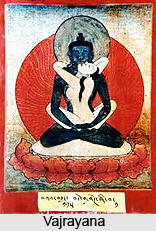
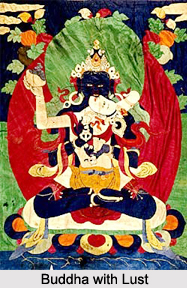
Love and Passion are important part of Tantric Buddhism. Buddhist iconographers use sexual polarity to symbolize the twin concepts of insight and compassion. All goddesses are the symbols of the insight and the gods represent the compassion. This union is represented visually by showing two deities in the sexual congress. In Sanskrit such images are called Yuganaddha. This sexual metaphor is also used to denote the highest stage of Yoga in which everything is free from polarity or any discrimination. The Buddhist couples of Tantric iconography celebrate the deep harmony of sexes, which ultimately devoted to the realization of the ultimate truth.
Gods of the Hindu pantheon are not recognised in Buddhist Tantra. It does not mention about Shakti and Shaktism. The Buddhists have Upaya and Prajna. The Buddhists advocate Sunyata. As far as goal and ways to achieve it are concerned it has similarities to Hindu Tantra. Mantra, guru and Mandala are recognised in Buddhist Tantra too. It is claimed that names of Hindu deities which end or begin with Vajra owe their origin to Buddhist Tantra. Buddhist Tantra recognised Puranic deities as Ganesha and Sarasvati. Buddhist Tantra does not emphasise the cult of Mother Goddess as in Hindu Tantra. However it recognises her. Guhyasamajatantra and Manjusri-mulkalpa are the Buddhist Tantras which date back to a period earlier than 650 A.D. Some amazing powers like transformation of a dragon into an insect, crossing rivers on foot are attributed to the Buddha in some works. Literary evidences are pointed out to show that the Buddha was influenced by Tantric ideas.