


 Sikhism is one of the important religions in India and there are many festivals celebrated by Sikh/Punjabi community. Most of the Sikh festivals are events to commensurate the birth and teachings of 10 gurus of Sikhs and their teachings. The birthdays of all Gurus especially the first and last Sikh Guru is celebrated on a grand level. The gurus are of prime importance within the Sikh community and this is also evident that the Sikh festivals will revolve around the lives of the Sikh gurus. The Sikh community celebrates various Sikh festivals based on the Nanaksahi calendar. As the Nanaksahi calendar is not yet widely accepted within the Sikh community some of the Sikh celebrations take place in accordance to the Hindu calendar. The festivals that hold significant importance in Sikh festival calendar are: Sikhism is one of the important religions in India and there are many festivals celebrated by Sikh/Punjabi community. Most of the Sikh festivals are events to commensurate the birth and teachings of 10 gurus of Sikhs and their teachings. The birthdays of all Gurus especially the first and last Sikh Guru is celebrated on a grand level. The gurus are of prime importance within the Sikh community and this is also evident that the Sikh festivals will revolve around the lives of the Sikh gurus. The Sikh community celebrates various Sikh festivals based on the Nanaksahi calendar. As the Nanaksahi calendar is not yet widely accepted within the Sikh community some of the Sikh celebrations take place in accordance to the Hindu calendar. The festivals that hold significant importance in Sikh festival calendar are:
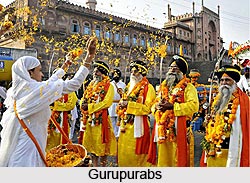
Gurupurabs The Gurupurabs generally commemorate the birth or death anniversaries of the Sikh gurus. All the ten Sikh Gurus have their birth and death anniversaries marked in the Nanaksahi calendar. But it is the birth anniversaries of Guru Nanak and Guru Gobind Singh that are widely celebrated with galore at Gurudwaras and Sikh houses throughout the country. On the other hand the martyrdom of Guru Arjan Dev and Guru Teg Bahadur are acknowledged by the Sikh community as Saheedi Gurpurab. 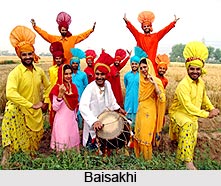
Sikhs worship Guru Granth Sahib Ji - a holy scripture for the Sikhs, which was compiled by their first Guru Nanak. His successors further edited and added on into the holy book. Devotees even circumambulate this Holy Scripture and bow their heads in devotion before it. Various festivals celebrated in Sikhism are celebrated by taking the scripture out in public processions. Fireworks, distribution of sweets as "Prasad" and feasts at the Gurudwara are all an inseparable part of these festivities. Music is considered to be the strongest medium to connect with the supreme in Sikhism hence playing of "Gurbani" (musical reading of the scripture); hearty dances and their martial arts display treat the eyes of viewers during the festivals. Baisakhi Baisakhi is New Year's Day in Punjab. It falls on the month of Vaisakh. This festival marks the ripening of the Rabi harvest. It was on this day that the tenth Sikh Guru, Guru Gobind Singh, founded the Khalsa (the Sikh brotherhood) in 1699. For Sikhs, this is a collective birthday. It is celebrated on April 13, though once in 36 years it occurs on 14th April. Holla Mohalla Holla Mohalla is a Sikh festival celebrated in the month of Phalguna, a day after Holi. An annual festival held at Anandpur Sahib in Punjab, Holla Mohalla was started by the tenth Sikh Guru, Gobind Singh, as a gathering of Sikhs for military exercises and mock battles on the day following the festival of Holi. It reminds the people of valour and defense preparedness, concepts dear to the Tenth Guru who was at that time battling the Mughal Empire. On this three-day festival mock battles are held followed by music and poetry competitions. The Nihang Singhs (members of the Sikh army that was founded by Guru Govind Singh) carry on the martial tradition with mock battles and displays of swordsmanship and horse riding. They perform daring feats, such as Gatka (mock encounters), tent pegging, bareback horse-riding and standing erect on two speeding horses. 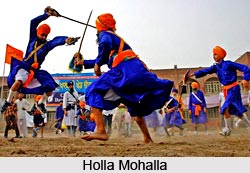
The tenth guru Gobind Singh felt that Holi had lost its original meaning over the years. It was no longer a celebration to reaffirm fraternity and brotherhood. In 1757 AD he decided to revive the spirit of Holi and weave its essence into a festival created in the Khalsa traditions. Maghi Maghi is the occasion when Sikhs commemorate the sacrifice of forty Sikhs, who fought for Guru Gobind Singh Ji. The day of Maghi is observed to honour the heroic fight of the Chali Mukte, or the Forty Liberated Ones, who sacrificed their own lives defending an attack by the imperial army marching in pursuit of Guru Gobind Singh. The action took place near a pool of water, Khidrane di Dhab, on 29 December 1705. Sikhs celebrate the Maghi with an end to end recital of the holy Guru Granth Sahib and religious rituals in all the Sikh Gurudwaras. On the eve of Maghi falls the common Indian festival called the Lohri when bonfires are lighted in Hindu homes and alms are also distributed. Bandi Chhor Divas The Sikh celebration of the return of the sixth Nanak, Guru Hargobind from detention in the Gwalior Fort coincides with Hindu festival of Diwali. The Sikhs celebrate this day as Bandi Chhor Divas i.e., "the day of release of detainees", because in 1619 the sixth Nanak had agreed to his release on the condition that the other fifty-two detainees would also be released.  Mughal Emperor Jahangir had imprisoned the sixth Nanak because he was afraid of the Guru's growing following and power. The Sikhs on this day, which generally falls in October-November, hold a one-day celebration in the Gurudwaras. So in the evening, illuminations are done with Deewé (earthen oil lamps) or candles and fireworks. The celebrations are held both in the Gurudwaras and in homes.
Apart from the various festivals the Sikhs follow certain rituals during the birth of a child and also follow a number of marriage as well as funeral rites. During the performance of these rites and rituals, the presence of Guru Granth Sahib, the holy Sikh scripture, is mandatory. |
| |||



Sikh Festivals
| All the important Sikh festivals revolve around the lives and works of the ten Sikh Gurus. |
| ||||||||||||||||||||||||||||

