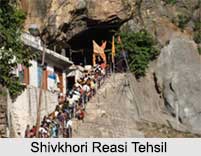
 Shivkhori is a prominent cave shrine of Hindus devoted to Lord Shiva. Reasi, a city known for its valour and is one of the oldest towns of the Jammu and Kashmir. It was the seat of earlier "Bhimgarh" state which is said to have been established by Raja Bhim Dev around in the 8th century.
Location of Shivkhori Reasi Tehsil
Shivkhori Reasi Tehsil is located in Reasi tehsil of Udhampur district, Jammu and Kashmir. Shivkhori is located in the village Ransoo of Pouni block in Reasi. It is situated on a small hillock about 140 kilometres north of Jammu, 120 kilometres from Udhampur and 80 kilometres from Katra.
Legends of Shivkhori Reasi Tehsil
Shivkhori has its own share of legends. The crowning story of Shivkhori associates with a demon named "Bhasmasura". After a prolonged meditation of Lord Shiva, Bhasmasura obtained the boon to end the life of any one with that power. Ironically, the demon tried to end the life of the Lord Shiva himself. On seeing the evil plan of the demon, Lord Shiva ran to save his life from the power of Bhasmasura and entered this very cave, presently known as Shivkhori. After this, Lord Vishnu in the mask of "Mohini" (one of the 25 avatars of Vishnu) came forward and asked the demon to dance with her according to her tune. As and when the demon started dancing, Bhasmasura put his hand on his head and with his own power destroyed himself. According to legend, 33 crore deities exist in this cave in shape of "pindis" and natural milky water cascades down from the top of the cave.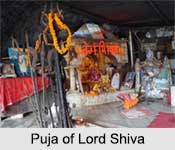
Another legend speaks of a Muslim shepherd who discovered the Shivkhori cave. The shepherd was searching his missing goat and went inside to find the goat. Nevertheless, he was very much taken aback to see a number of saints inside the cave, who were blessed with Lord Shiva`s divine power and he too started his "puja" there. Later on, the shepherd disclosed this piece of information to a number of other people in spite of his pledge made to the saints not to disclose about them in the cave.
An interesting trivia about Shivkhori is that about 40-50 years ago, very few people knew about the cave. Earlier times, people saw a footfall of `yatris` (pilgrims) in 1000s, but today the number of devotes has risen to almost 3 lakhs (300,000). A 3-day "Shivkhori Mela" takes place on Mahashivratri, when thousands of pilgrims from different parts of the country visit the shrine to seek blessings of the Lord.
Attraction of Shivkhori Reasi Tehsil
Shivkhori attracts thousands of devotees every year. Shivkhori refers to Lord Shiva`s cave. It is about 200 meters long, 1 meter wide and 2-3 meters high natural cave that contains a natural lingam (swyambhu), which according to the people, is endless. The first entrance to the cave is so wide that 300 devotees can be accommodated at a time simultaneously. It is actually double chambered, which is quite spacious to accommodate large people. The inner chamber of the cave is smaller. The passage from outer to inner chamber is low and small; at one point it divides itself into two parts. One of these is believed to head for Kashmir, where "Swami Amarnath" cave exists. To reach the sanctum sanctorum, one has to crouch low, crawl or bend his/ her body sideward where a naturally created image of Lord Shiva, about 4 meters high, is visible. The cave abounds with a number of other natural objects bearing resemblance to Goddess Parvati, Ganesha and Nandigan. The cave roof is engraved with snake formations, and water trickles through these on the Shiva lingam. Pigeons are also seen here in Shivkhori like the Buddha Amarnath Temple which represents good omens for pilgrimages.
Visiting Information of Shivkhori Reasi Tehsil
Pilgrims have to traverse about 3 kilometres track on foot, which has recently been constructed by the Shivkhori Shrine Board, Ransoo, headed by the District Development Commissioner, Udhampur as chairman and Sub Divisional Magistrate, Reasi as Member Secretary. The nearest domestic airport is Jammu and is well connected to all major locations/ cities in the country. Visitors Jammu and Kashmir Tourism Development Corporation also runs its fleet of Tourist transport (Cabs, Vans and Mini Bus) to Shivkhori from Jammu as well as Katra on daily basis. Visitors can reach either Jammu or Katra by Train. Jammu Tawi Railway Station is approximately 107 kilometres from Shivkhori.