


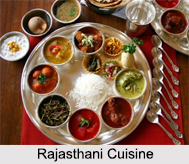
 Rajasthani Cuisine has been influenced by Rajput and Brahmins as well as by its arid topography. It is a place known for its variety of lip smacking snacks. Rajasthani Cuisine consists of food that stays for long and requires less or no heating. Water scarcity has affected on their cooking. The cuisine of Rajasthan is a delectable blend of multipleregional cuisines such as Mewari, Marwari, Shekhawati and Bikaneri. Rajasthani Cuisine has been influenced by Rajput and Brahmins as well as by its arid topography. It is a place known for its variety of lip smacking snacks. Rajasthani Cuisine consists of food that stays for long and requires less or no heating. Water scarcity has affected on their cooking. The cuisine of Rajasthan is a delectable blend of multipleregional cuisines such as Mewari, Marwari, Shekhawati and Bikaneri.
Features of Rajasthani Cuisine A lot of ghee is a prerequisite to most Rajasthani dishes. Besan is another ingredient that Rajasthani people relish. Use of milk and milk products instead of water is unique to this part, as it curtails water consumption and adds that extra flavour to the dish. The people of Rajasthan have moulded their culinary styles in such a way that many of their dishes can be shelved for several days and served without heating. 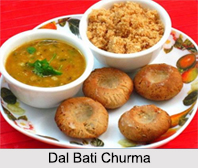 Cooking in Rajasthan has its own distinctive taste and the simplest ingredients go into the preparation of most dishes. Dried lentils and beans from indigenous plants are used liberally. The staple grains of Rajasthan are bajra and corn. The popular chutneys of Rajasthan are made from locally available spices like turmeric, coriander, mint and garlic. Cooking in Rajasthan has its own distinctive taste and the simplest ingredients go into the preparation of most dishes. Dried lentils and beans from indigenous plants are used liberally. The staple grains of Rajasthan are bajra and corn. The popular chutneys of Rajasthan are made from locally available spices like turmeric, coriander, mint and garlic.
Various Delicacies of Rajasthan The signature delicacies of Rajasthan are ‘Dal Baati Churma’ and ‘Kachori’ to sweets like ‘Ghevar’, ‘Imarti’ and ‘Malpua’. Dal Baati Churma and Bikaneri Bhujia have garnered both national and international popularity. ‘Bajre ki Roti’ is very popular and healthy flat bread that is relished across Rajasthan. It is generally savoured with onions and ‘Lasun ki Chutney’. This combination has remained a staple food for the locals. A soup of legumes, flavoured with red chilli peppers, yogurt or milk and sometimes vegetables such as Okra, Jackfruit, Eggplant, Mustard or Fenugreek leaf are often eaten by the Rajasthani people. 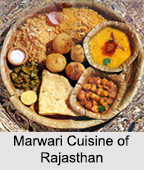
Marwari Cuisine of Rajasthan Marwari Cuisine of Rajasthan comes in two varieties i.e. the food eaten by the common man that includes use of various spices and herbs and the food of the Marwari Jains that is prepared without using onions, garlic or for that matter any ingredient growing under the soil except for ginger and groundnuts. There are a variety of Marwari recipes ranging from ‘Bharwan Gatte’, ‘Arbi ka Khatta Shaak’, ‘Chane Jaiselmer Ke’, ‘Dahiwale Amrud’, ‘Ker Sangri’, ‘Papad Rolls’, ‘Mooli Bajra Roti’, ‘Lapsi’ and many more. Desserts of Rajasthan Besides spicy flavours, each region is well known for its popular sweets. Rajasthan, being one of the big states of India, has many regions. Each region is known for its special sweets. Jodhpur and Jaisalmer are famous for ‘Laddoos’, Pushkar for ‘Malpua’, Bikaner for ‘Rasgulla’, Udaipur for ‘Dil Jani’, Jaipur and Alwar for ‘Mishri Mawa’ and ‘Ghevar’, Jodhpur for ‘Mawa Kachori’, Ajmer for ‘Sohan Halwa’ and the famous ‘Jalebi’ can be found in all cities of Rajasthan. |
| |||



Rajasthani Cuisine
| Rajasthani Cuisine is known to be very delicious and yummy. Their food is usually spicy and makes use of loads of ghee, without which no dish is complete. |
| ||||||||||||||||||||||||||||

