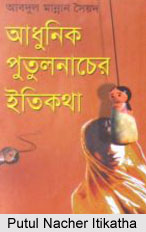
 In a rural backdrop, Putul Nacher Itikatha, represents the hypocrisy and intricacy of the individuals. Unlike the contemporary narratives, centering society as the protagonist, Putul Nacher Itikatha principally concerns about the individuals living in the society, who has contaminated the abstract society, with their duplicity and darkness of mind. The pettiness and dejection of existence in the village context is the principal idea of which the novel is concerned about.
Author:
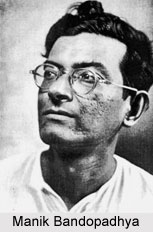
Manik Bandopadhya, one of the renowned novelist of the transition period, born on 19 May 1908. He with a deep insight has made a piercing analysis of human condition and the intricacies of their behavior, which dominates their interrelationship in the society. He draws the theme of his novel from a variety of human conditions and situations, which he experienced. The contemporary human conditions being his primary theme, his novels are the vivid pictures of the human subsistence and their agonized existence.
Synopsis:
Based on the sensitive political situation of the post war period, Putul Nacher Itikatha is not the story of a single individual, as a victim of the contemporary situation. Rather Putul Nacher Itikatha delineates the condition of different individual, depicting the variety of life in rural Bengal.
 Not even the individuals, the savage hypocrisy and the dark alleyways of human psychology stands as a protagonist of the novel, Putul Nacher Itikatha. The touchy topic of hypocrisy in the village, where an elderly couple is consecrated as saints after committing morphine induced suicide. Hypocrisy was more intensified when a village girl was married to an affluent businessman, who treats him as a kept woman. To satisfy her husband, she attired herself in the robe of a "keep" and has developed the habit of drinking. Being completely used by her husband when she came back to her village home, to find out a shadow of her former self she had to endure the comments of the pretentious villagers inflicting her as corrupted women.
Putul Nacher Itikatha belongs to the mainstream world Literature in its sources of conflict of father against son; education against tradition; village against city; man against fate and the inexhaustible enigma of woman and man. Apparently the title "Putul Nacher Itikatha", will justify the narrative depending on the fact that it depicts individual as the puppet of destiny. But a thorough contemplation of the narrative will signify the narrative Putul Nacher Itikatha as a dissent against those who make people puppets. Putul Nacher Itikatha is not a vigorous revolt; but a sympathetic mild and relentless protest. Hence the title, "Putul Nacher Itikatha" justifies the narrative both on an apparent and imperceptible level.
The most controversial, yet highly acclaimed novel, "Putul Nacher Itikatha" was published serially in a magazine called Bharatbarsha in 1935. In spite of being much debated, the novel was widely translated and published as a book in the year 1936.