


 The legacy of ancient glory is reverberated in the majesty of various artifacts and monumental structures of Jaisalmer in Rajasthan. The places for tourism in Jaisalmer have attracted tourists and visitors from far off locales. Jaisalmer houses exquisite forts made up of mud, which are special attractions of this city. The desert region casts a charm in tourists' minds. The tourist spots in Jaisalmer will enable the visitors to comprehend better the history of this city. The legacy of ancient glory is reverberated in the majesty of various artifacts and monumental structures of Jaisalmer in Rajasthan. The places for tourism in Jaisalmer have attracted tourists and visitors from far off locales. Jaisalmer houses exquisite forts made up of mud, which are special attractions of this city. The desert region casts a charm in tourists' minds. The tourist spots in Jaisalmer will enable the visitors to comprehend better the history of this city.
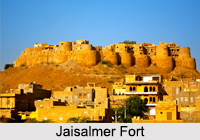
Places for Tourism in Jaisalmer There are several places for tourism in Jaisalmer which are extremely popular among tourists and they flock to these sites to experience the history, culture and tradition of Rajasthan. Some of the places have been discussed about below: Jaisalmer Fort: It is an indispensable part of the history of Jaisalmer. It is built in yellow sandstone. Often referred to as the 'golden fort' of Rajasthan, it is a splendid sight to behold. Bhati Rajput ruler, Maharawal Jaisal, constructed the monument around 800 years ago. The main feature of the bastion is its massive structure that served as a superb defense for the kingdom. The fort had a city within it. Desert National Park: It is one of the most popular places for tourism in Jaisalmer. This national park is situated in the western part of Rajasthan state. It is one of the 'largest national parks'. It encompasses an area of approximately 3162 sq. km. It bears the features of the ecological system of the Thar Desert of India. Almost twenty percent of the park is covered with beautiful sand dunes. Hilly rocks and contracted salt lakebeds, 'intermedial areas' and permanent dunes also form a large part of park's topography. Wood Fossil Park: This park is a landmark of Jaisalmer. It lies at a distance of near about 17 km from Jaisalmer city. It is located on Barmer road. It houses ancient fossils, which date back to some one 180 million years back. 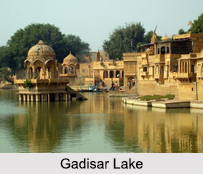 Bada Bagh: This lies in the vicinity of Jaisalmer. Bada Bagh is a fertile oasis, with a large ancient dam on the banks of a man-made lake. The place is glorified by the lake and the dam. Bada Bagh: This lies in the vicinity of Jaisalmer. Bada Bagh is a fertile oasis, with a large ancient dam on the banks of a man-made lake. The place is glorified by the lake and the dam.
Jain Temples in Jaisalmer: There are several Jain temples that are situated within the secure walls of the Jaisalmer Fort. All these temples are connected by a series of corridors and walkways. The Jain Temples are well known for their sheer magnificence. Parsvanath temple, Chandraprabhu temple, Rishabdev temple, Sambavnath temple, Shitalnath temple, Shantinath temple and Kunthanath temple in the fort are worth checking out. Havelis in Jaisalmer: The ‘Havelis’ are not as grand as the palaces yet the craftsmanship is worth noticing. Patwon ki Haveli, Salim Singh ki Haveli and Nathmal ki Haveliare the most popular havelis in Jaisalmer. Gadisar Lake: It was the main source of drinking water in the old times. The tank was built in 1367 by Maharaja Gadsi Singh and there are many small shrines and temples festooned all around the lake. Museums in Jaisalmer: One of the best places to know more about the history of Jaisalmer is the museum. The museums in Jaisalmer are Desert culture Centre and Museum, Folklore Museum, Government Museum and Thar Heritage Museum. Camel Safari: A ride on a camel in the Thar Desert is one of the most exciting things to do in Jaisalmer. It allows tourists to explore the remote and isolated places in the midst of the desert. 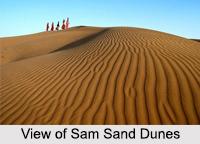 Sam Sand Dunes: Approximately 42 kilometers from Jaisalmer, the Sam Sand Dunes in the outskirts is another tourist place to see in Jaisalmer. The stretches of sweeping dunes, camel safari along with sunset are the main attractions of this place. The folk music and dance of the Rajasthani folklores are also popular in this place. The best time to visit Sam Sand Dunes is at the time of the Jaisalmer Desert Festival, which is usually held in the month of February every year. Sam Sand Dunes: Approximately 42 kilometers from Jaisalmer, the Sam Sand Dunes in the outskirts is another tourist place to see in Jaisalmer. The stretches of sweeping dunes, camel safari along with sunset are the main attractions of this place. The folk music and dance of the Rajasthani folklores are also popular in this place. The best time to visit Sam Sand Dunes is at the time of the Jaisalmer Desert Festival, which is usually held in the month of February every year.
Other Places for Tourism in Jaisalmer Apart from these places there are some other places for tourism in Jaisalmer, which are Tanot Mata Temple, Vyas Chhatri, Mandir Palace, Kuldhara Village, Surya Gate, Khaba Fort, Lodhruva, Sati Rani, Amar Sagar, Mool Sagar, Khuri village etc. These sites are equally popular and worth visiting for the tourists. Visiting Information to Jaisalmer Jaisalmer Railway station is the major rail station of this city; nearest airport is Jaisalmer Airport. This city is well connected to all parts of India by road as well; it can be reached by road via National Highway 11. |
| |||



Home > Travel > Indian Cities > Cities of India > Cities of Rajasthan > Jaisalmer > Tourism in Jaisalmer
Tourism in Jaisalmer
| Camels safaris, National Park, Jaislamer Fort, and Temples are some of the places for tourism in Jaisalmer that have enhancing tourist count. |
| ||||||||||||||||||||||||||||

