Mudiyettu is the folk ritual theatre of Kerala, where the mythological tale of the battle of Goddess Bhadrakali, an incarnation of Hindu Goddess Kali, with the demons Daarika and Daanavendra, is enacted through a dance drama. A community ritual, Mudiyettu is a part of the Bhagavathi cult, popular in South India, and prevalent in the Kottayam, Thrissur, Idukki and Ernakulam districts of central Kerala. It is performed annually in the temples of Goddess Bhadrakali, referred to as "Bhagavathi Kavus", in different villages along the rivers Chalakkudy Puzha, Periyar and Moovattupuzha, by the male members of the Marar and Kuruppu communities. However the entire community contributes and participates in it. It is held after the harvest, between the months February and May, starting on an auspicious day and lasting up to a length of a week or even upto 41 days. Mudiyettu has a history of over 10 centuries and finds mention in the UNESCO"s Representative List of the Intangible Cultural Heritage of Humanity, the second art form from Kerala after Koodiyattam to be featured in the list, in the year 2010.
Theme of Mudiyettu
The Mudiyettu enactment displays the mythological story of the battle that Goddess Bhadrakali fought with the two Asuras (demons), Daarikan and Daanavendran, who were a nuisance to Devas (Gods) and mankind alike. The demons had undergone intensive Tapas (penance) to appease Lord Brahma, to make Him appear before them and elicit a Varam (boon) from Him in order to gain immortality. The intensive penance made Brahma appear before them. When asked what they desired, they out-rightly demanded immortality. The unexpected demand took Brahma off-guard and the Lord hesitatingly said that death is inevitable for anybody who has taken birth. The adamant Asuras conceded some adjustments and demanded that they be empowered that no males can ever kill them. The surprised Brahma asked them why they weren"t asking immunity from females. The enraged Asuras retorted that no female can ever cause any harm to them. Brahma ultimately gave them the boon saying no male can ever kill them, knowing a female Bhadrakali will be there to kill them.
Armed with the boon, Daarika and Daanavendra became immensely powerful and arrogant, going on to conquer the world, defeating even Indra, the king of the Gods. As their atrocities became intolerable, the sage Narada requested Lord Shiva to contain them. Shiva agreed, circumventing Brahma`s boon by declaring that the Asuras would be killed by the Goddess Bhadrakali. The battle ended with the killing of both the Asuras by the Goddess and not by any male or any other human.
 Performance of Mudiyettu
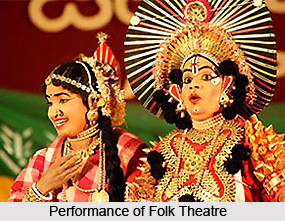
There is as such no rehearsal or preparation involved in playing Goddess Bhadrakali. The performance goes in a progression from Lord Shiva, Narada, the two demons to Bhadrakali. A complete Mudiyettu performance requires total 16 performers, including percussionists, and the vocalists. There are also existing regional differences in the attire and style of performance of Mudiyettu. Thus, in the Koratty style of Mudiyettu, Bhadrakali exhibits a bare torso, covered by a breast-shaped plank. In the Keezhillam and the Pazhoor styles, Goddess Bhadrakali"s attire is a full upper body dress. It is interesting to note that the two forms of dance, Mudiyettu and Kathakali have become interlinked even though Mudiyettu predates Kathakali. Many epigraphists have traced its evolution as an art form since 9th or 10th century AD.
Community Role and Relevance in Mudiyettu
Mudiyettu is a communal undertaking in which each caste of the village plays a specific role. While the Parayans are in charge of bamboo artefacts and leather for the drums, the Tandans have the responsibility of the areca nut fronds required for the masks and headgear. Painting of the masks is done by the Ganakans who also sing during the performance. The Maran community prepares the torches and keeps them ready to be used. The torches are kept burning by the Kuruvans and the laundry of the deity"s dress is entrusted to the Veluthedans (Patiyans), who wash the clothes to be used for the deity"s dress. The Brahmins initiate the rituals while the Kurups (Marars) draw Bhadrakali"s picture.
Preservation and Transmission of Mudiyettu
Mudiyettu is both a performing art and a social ritual practice, with its own oral traditions and expressions, knowledge and practices and the traditional craftsmanship. It is the community that has traditionally encouraged and trained the next generation to preserve the art form. Being an oral tradition there is no school or institution to give training on Mudiyettu. Mudiyettu depends on direct, face to face transmission through the traditional Guru-Shishya tradition. The younger generation is engaged as apprentices or assistants by elders and senior performers, during the course of the performance.
There are presently only 4 traditional families of regular performers of Mudiyettu existing in India - Kunjan Marar Mudiyettu Kalakendra at Thirumarayoor, Ernakulam district, led by Thirumarayoor Muraledhara Marar and Girijan Marar, Sankarankutty Smaraka Mudiyett troupe at Keezhillam, led by Keezhillam Unnikrishnan and Keezhillam Gopalakrishnan, Varanattu Kurup at Koratty led by Kizhake Varanattu Nanu Kurup and Sankaranarayana Kurup, and Sreebhadra Mudiyettu Sangam Thirumarayoor, led by Thirumarayur Vijayanmarar.
The government of India and the government of Kerala have taken some steps to promote academic interest in Mudiyettu and to promote it as an important part of tourism. Rampant commercialisation, globalisation and onslaught of technology have had a negative impact on Mudiyettu, just as they have pushed many traditional and ritual art forms to the verge of extinction. Mudiyettu"s recognition by UNESCO is expected to improve the frequency of performances, create research interests and archival repositories of the traditional ritual art.