


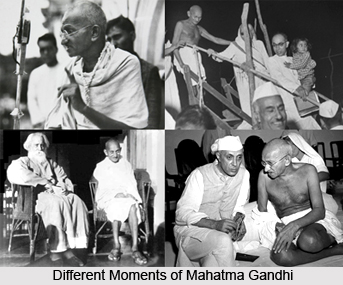
 The role of Mahatma Gandhi in Indian Freedom Struggle is considered the most significant as he single-handedly spearheaded the movement for Indian independence. The peaceful and non-violent techniques of Mahatma Gandhi formed the basis of freedom struggle against the British yoke. The role of Mahatma Gandhi in Indian Freedom Struggle is considered the most significant as he single-handedly spearheaded the movement for Indian independence. The peaceful and non-violent techniques of Mahatma Gandhi formed the basis of freedom struggle against the British yoke.
Mohandas Karamchand Gandhi was born on October 2nd, 1869. After he came back to India from South Africa, where he worked as a barrister, Gopal Krishna Gokhale, who led the Congress party, introduced Mahatma Gandhi to the concerns in India and the struggle of the people. The Indian independence movement came to a head between the years 1918 and 1922. A series of non-violence campaigns of Civil Disobedience Movement were launched by the Indian National Congress under the leadership of Mahatma Gandhi. The focus was to weaken the British government through non cooperation. The protests were mainly against abolition of salt tax, land revenue, reducing military expenses etc. Champaran and Kheda Agitations The Kheda Satyagraha and Champaran agitation in 1918 was one of Gandhi's first significant steps to achieve Indian independence. Mahatma Gandhi went to Champaran (Bihar) in 1917 at the request of the poor peasants to enquire about the situation as they were compelled by British indigo planters to grow indigo on 15% of their land and part with the whole crop for rent. In the sufferings of a devastating famine, the British levied an oppressive tax which they insisted on increasing. At the same time, Kheda in Gujarat was also experiencing the same problem. Hence, Mahatma Gandhi started reforming the villages, building of schools, clean-up of villages, construction of hospitals and encouraging the village leadership to denounce many social tribulations. The British police arrested him on the charge of creating unrest. However, the impact of reformation changed after this act and hundreds of people protested and rallied outside the police stations and courts. They demanded his release, which the court unwillingly granted. Gandhi led planned protests against all the landlords, who were exploiting the poor farmers. Finally Mahatma Gandhi became successful in forcing the British to agree with his demands of reforming the farmers. During this agitation people addressed Mohandas Karamchand Gandhi as Bapu. Rabindranath Tagore accorded Mahatma (Great Soul) title to Gandhi in the year 1920. Non Cooperation Movement The Gandhi Era in the Indian Freedom Struggle took place with the Non Cooperation Movement. This movement was led by Mahatma Gandhi and the Indian National Congress. This was the first-ever series of nationwide movement of non-violent resistance. The movement took place from September 1920 until February 1922. In the fight against injustice, Gandhi's weapons were non-cooperation and peaceful resistance. But after the massacre and related violence, Gandhi focused his mind upon obtaining complete self-government. This soon transformed into Swaraj or complete political independence. Thus, under the leadership of Mahatma Gandhi, the Congress Party was re-organised with a new constitution, with the aim of Swaraj. Mahatma Gandhi further extended his non-violence policy to include the Swadeshi Policy, which meant the rejection of foreign-made goods. Mahatma Gandhi addressed all the Indians to wear Khadi (homespun cloth) instead of British-made textiles. He strongly appealed to all Indians to spend some time spinning khadi for supporting the independence movement of India. This was a policy to include women in the movement, as this was not considered a respectable activity. Moreover, Gandhi also urged to boycott the British educational institutions, to resign from government jobs, and to leave British titles. Gandhi and Jalliwanabagh Massacre Nobel laureate Rabindranath Tagore resigned the title knight from the British soon after the Jalianwalabagh Massacre as a protest. When the movement reached great success, it ended unexpectedly after the violent clash in Chauri Chaura, Uttar Pradesh. Following this, Mahatma Gandhi was also arrested and sentenced to 6 years imprisonment. Indian National Congress was divided into two segments. Furthermore, support among the Hindu and Muslim people was also breaking down. However, Mahatma Gandhi only served around 2 years and was released. Dandi March Mahatma Gandhi returned to the forefront again in 1928. On March 12, 1930 Gandhi launched a new Satyagraha against the tax on salt. He started the historic Dandi March, by walking from Ahmedabad to Dandi, to break the law that had deprived the poor of his right to make his own salt. Gandhi broke the Salt law at the sea beach at Dandi. This movement stimulated the entire nation and it came to be known as Civil Disobedience Movement. On 8th May, 1933, he started a 21-day fast of self-purification in order to help the Harijan movement. Quit India Movement Mahatma Gandhi again became active in the political arena after the outburst of World War II in 1939. On August 8, 1942 Gandhi gave the call for Quit India Movement or Bharat Chhodo Andolan. Soon after the arrest of Gandhi, disorders broke out immediately through out the country and many violent demonstrations took place. Quit India became the most powerful movement in the freedom struggle. Thousands of freedom fighters were killed or injured by police gunfire, and hundreds of thousands were arrested. He called on all Congressmen and Indians to maintain discipline via non violence and Karo Ya Maro (Do or Die) in order to achieve ultimate freedom. On 9th of August, 1942, Mahatma Gandhi and the entire Congress Working Committee were arrested in Mumbai. In view of his deteriorating health, he was released from the jail in May 1944 because the British did not want him to die in prison and enrage the nation. The cruel restraint of the Quit India movement brought order to India by the end of 1943 although the movement had modest success in its aim. After the British gave clear signs of transferring power to the Indians, Gandhi called off the fight and all the prisoners were released. Partition and Indian Independence In 1946, upon persuasion of Sardar Vallabhbhai Patel, Mahatma Gandhi reluctantly accepted the proposal of partition of India and independence offered by the British cabinet, in order to evade a civil war. After independence, Gandhi's focus shifted to peace and communal harmony. He fasted for abolition of communal violence and demanded that the Partition Council compensated Pakistan. His demands were fulfilled and he broke his fast. Mohandas Karamchand Gandhi was, thus, able to bring the whole nation under one umbrella to fight the British. Gandhi developed and improved his techniques gradually to assure that his efforts made significant impact. |
| |||



Home > Society > Indian Personalities > Indian Freedom Fighters > Mahatma Gandhi > Mahatma Gandhi in Indian Freedom Struggle
Mahatma Gandhi in Indian Freedom Struggle
| Mahatma Gandhi played the most noteworthy role in Indian Freedom Struggle against the British. |
| ||||||||||||||||||||||||||||

