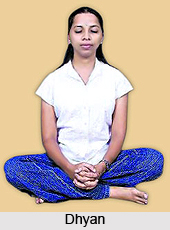
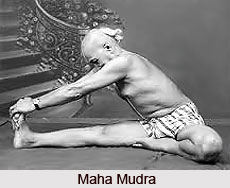
 To perform it, simply sit on the ground, and place the left heel on the perineum, being careful not to sit on it. The right leg is kept straight and at a right angle to the body. Clasp your right foot with both hands, not merely touching the foot but holding it firmly. Concentrate within, turning your attention to the eyebrow centre.
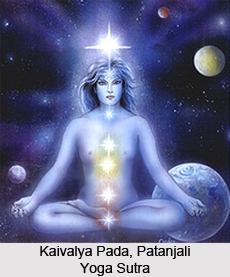
Now fix your gaze inwards, and clearly visualise the sushumna nadi as a radiant shell running vertically through the centre of your body from top to bottom. Inhale. Then drop your chin and press it firmly to the chest and hold the breath, continuing to visualise the sushumna nadi. The visualisation is only of the psychic tube and not of the individual chakras. Since the heel of the foot is on the perineum, and since your attention has also been focused on the eyebrow centre, you are immediately aware of where the sushumna begins and ends.
After holding the breath to your capacity, raise the chin and exhale slowly. This is the first half of the procedure. Repeat it but this time place the left leg out straight and the right foot on the perineum.
However, this is the second half of one complete rounds of the maha-mudra. If necessary, one can do several complete rounds of maha-mudra. It may be necessary to visualise the sushumna clearly. However, after finishing with maha-mudra, one should perform the maha-bandha.
Maha-Bandha
Place the left heel against the perineum. Place the right foot on the left thigh. Inhale, do the chin lock, and place the palms on the floor. As part of the maha-bandha, you should perform the maha-bandha, contracting the muscles to close or "bind" the anus while also contracting the muscles in such a way so as to pull up the alimentary canal.
This maha-bandha must be firmly kept while you continue with the maha-bandha. Contemplation is of the eyebrow centre. And as in maha-mudra, you visualise the sushumna. As before, you raise the chin, and exhale slowly.Finally, still assuming the maha-bandha, you perform the maha-vedha.
Maha-Vedha
Take a deep breath and hold it and, while dropping the chin again into jalandhara-bandha, you lift and raise your buttocks off the ground, your two palms pushing you from the ground. Then drop the buttocks, letting it gently strike the floor.
The Maha-mudra, maha-bandha, and maha-vedha should practiced togetherand all three produce some effects upon the perineum. These are performed because they help create sensitivity about the beginning of the sushumna. The eyebrow centre is the terminus of the sushumna. The concentration should be free to move through the entire field of the sushumna because the sushumna is not just top, middle, and bottom but one field, one sushumna! Here, this meditation is not fixed upon one thing; there is movement of the mind or chitta. The movement may be limited to the extent that the meditation is upon the sushumna only, but there is no limit on the movement of consciousness within that field.