Kundan Jewellery in India
|
Kundan Jewellery in India is one of the most exquisite forms of jewellery styles which is indigenous to the country. It was in much use during the Mughal era and involves the setting of carefully shaped and polished multicoloured gems into a pure gold base.
|
|
|
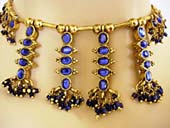 Kundan Jewellery in India is one of the oldest forms of jewellery worn and made in India. Kundan work is actually a form of gem setting in which gold foil is inserted between the stones and its mount. There is no indication that this technique was ever practised anywhere except in India, despite its obvious advantages, and despite the fact that its visual effect was much imitated in the surrounding regions. Kundan Jewellery in India is one of the oldest forms of jewellery worn and made in India. Kundan work is actually a form of gem setting in which gold foil is inserted between the stones and its mount. There is no indication that this technique was ever practised anywhere except in India, despite its obvious advantages, and despite the fact that its visual effect was much imitated in the surrounding regions.
Kundan, or hyper-purified gold, is beaten into narrow strips of foil and refined to the point at which it becomes 'tacky' at room temperature. At this degree of purity, it can actually form a molecular bond when pressure is applied to it by means of steel tools, which are first used to press the foil down around the stones, then to cut, shape and burnish it into any form that the artist may wish. Kundan can be applied over any rigid surface, and since there is no need for soldering to join the metal, it bestows almost complete freedom, whether the work is executed in conjunction with enamels or with previously set stones, or even with organic materials such as wood and ivory.
This was the only form of setting for stones in gold until claw settings were introduced under the influence of western jewellery in the nineteenth century. It was used to great effect during the reign of the Mughals in India. According to Abul Fazl, the historian of the Mughal emperor Akbar, it was because of the Kundan technique that the gold of the inlayer, or zar nisban was 'made so pure and ductile that the fable of the gold of Parviz which he could mould with his hand becomes credible.' Thus, the inlayer could cut his grooves as he wished and put as much or as little gold whenever and wherever he wanted, and set it with as many or as few stones as required. He was free to make his pieces as much a delight to see and to handle as his taste would allow. This level of taste was very impressive indeed and happily allied with incomparable technical means.
Often, there is seen a combination of Kundan work and enamelling in such a way that a single piece of jewellery has two equally beautiful surfaces. This kind of work, known as Meenakari, has enamel at the back end and Kundan set gems in the front. One of the latest applications in Kundan work is seen in the works of designers who use crystals, uncut diamonds or coloured glass as embellishments in accessories such as handbags and shoes as well as in traditional sarees and lehengas. This is called Kundan work because it looks similar to Kundan jewellery, with embroidery of stone set in metal surround.
|
|
|
|





