


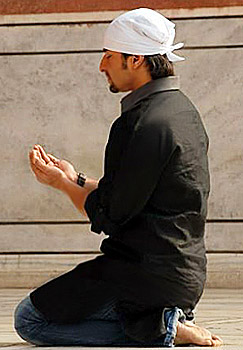
 Even if a Muslim observes other rules of piety but does not offer prayers, he will not inherit the Heavens. Hence, the saying of prayers is an essential exercise of Islamic faith. Hence, a Muslim is supposed to read the Namaz five times a day. A Muslim has to dedicate himself to Allah and the Islamic faith from dawn to night. Naturally prayers strengthen a Muslim in his resolve to perform his actions enjoined on him by avoiding prohibited acts. Even if a Muslim observes other rules of piety but does not offer prayers, he will not inherit the Heavens. Hence, the saying of prayers is an essential exercise of Islamic faith. Hence, a Muslim is supposed to read the Namaz five times a day. A Muslim has to dedicate himself to Allah and the Islamic faith from dawn to night. Naturally prayers strengthen a Muslim in his resolve to perform his actions enjoined on him by avoiding prohibited acts.
Prayers are to be said by purifying one's body and mind, and by having clean clothes. A Muslim has to wash the ordinarily exposed parts of his body, called wudu. Then he has to utter the name of Allah. He stands up as if he is standing before the throne of God begging for the forgiveness of his acts of commission and omission and asking for the divine help for realizing the Islamic destiny of His worshipper. The prayer starts with the utterance 'bismillah'. Each of the five prayers contains the al-Fatiha, the first sura of Quoran in which God is praised as the creator of Heaven and earth, and, strength from God is sought to walk in the straight paths of Islam. In every prayer, a Muslim has to assume several postures known as rak'a symbolizing one's surrender to God. Though their purposes are quite different these postures correspond to Yogic asana. Everyday a Muslim has to pray five times, viz: The first prayer is said at dawn before sunrise. It consists of two kneelings, at the end of which the worshipper sits to salute the Lord. The second prayer is in the afternoon. Then there is the afternoon prayer between mid afternoon and sunset. Both these prayers have four kneelings. The early evening prayer has three kneelings. The last evening prayer is just before sleep-time when the twilight disappears, which consists of four kneelings. 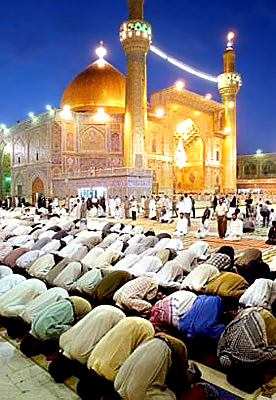 In addition to private prayers, a special virtue is attached to collective prayers, which are said each Friday, and in larger gatherings at the time of Eid al Fitr and Eid al-adka. By participating in-group mind in a congregation, the mental and spiritual powers of each participant are heightened. So the creative powers of the worshipper get additional impetus in the pursuit of a virtuous life. Whenever a Muslim prays either at home or in mosque, he faces towards the Ka'ba. This is to ensure unity amongst the Muslims. In the same way uniformity in words, their order and of postures ensure equality and brotherhood amongst all the faithful believers. In addition to private prayers, a special virtue is attached to collective prayers, which are said each Friday, and in larger gatherings at the time of Eid al Fitr and Eid al-adka. By participating in-group mind in a congregation, the mental and spiritual powers of each participant are heightened. So the creative powers of the worshipper get additional impetus in the pursuit of a virtuous life. Whenever a Muslim prays either at home or in mosque, he faces towards the Ka'ba. This is to ensure unity amongst the Muslims. In the same way uniformity in words, their order and of postures ensure equality and brotherhood amongst all the faithful believers.
Everyone sits on the floor and everyone in the mosque is equal in status. A niche in one of the walls, called a mihrab, shows the direction that the worshippers should face in order to face Mecca. Many mosques have a minaret, which is a tall thin tower. A muezzin stands at the top of the tower and calls Muslims to prayer at the five ritual times of the day. Women can also attend the mosque and when they do, they sit separately from the men. This is out of modesty and to prevent any distraction. It is more usual for women to pray at home. |
| |||



Islamic Prayers
| The saying of prayers is an essential exercise of Islamic faith. |
| ||||||||||||||||||||||||||||

