Indian Gypsum Mines - Informative & researched article on Indian Gypsum Mines
  Indianetzone: Largest Free Encyclopedia of India with thousand of articles Geography of India


in  
Art & Culture | Entertainment | Health | Reference | Sports | Society | Travel
Forum  | Free E-magazine
Geography of India : Indian Climate l Indian Mountains l Indian Forests l Indian Soil l Indian Vegetation l Animal Husbandry in India l Resources in India l Indian Demography l Indian Natural History l Indian Astronomy l Indian Industries l Indian Islands l Indian Airports l Zoos in India l Indian Mines and Minerals l Indian Physiography l Indian Transport l Indian Geology l Communication in India l Indian Trade l Indian Astronomers l Indian Telecommunications
Home > Reference > Geography of India > Indian Mines and Minerals > Indian Gypsum Mines
Indian Gypsum Mines
Gypsum, the sulphate of calcium with two molecules of water.

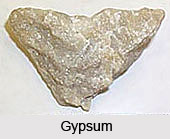
GypsumGypsum, , CaSO4.2H2O, is one of the most important industrial minerals in India.

Three varieties of gypsum are known namely:
  • Selenite

  • Alabaster and

  • Satin Spar


  • Selenite is crystalline. It is transparent to translucent. Massive variety is known as alabaster and fibrous or silky variety as satinspar, both pure white to dull white in colour unless otherwise tingled due to impurities. Commercial deposits are mostly found as marine beds. Gypsum is classed under minerals of evaporate group, though vein deposits and massive deposits in the limestone country formed due to interaction of limestone with sulphurous water are not uncommon.

    Bedded deposits are found associated with anhydrite (CaSo4, anhydrous gypsum), limestone, shale and clay. Gypsum beds are devoid of fossils. The origin of gypsum has been a subject of great interest in the past and continues to be a research problem for geologists today. As the gypsum directly enters into chemical reaction, the higher the percentage of CaSO4.2H2O content in gypsum the better is the plant performance and the greater is the production of ammonium sulphate.

    (Last Updated on : 23/03/2009)
      More Articles in Indian Mines and Minerals
     
    Indian Coal mines Indian Gold Mines Indian Gypsum Mines
    Indian Bauxite Mines Indian Chromite Mines Indian Iron Ore Mines
    Indian lead Mines Indian Limestone Mines Indian Manganese Mines
    Indian Phosphorite Mines Indian Silver Mines  
    Recently Updated Articles in Geography of India
  • Multi-purpose River Valley Projects in India
    Multi-purpose River Valley Projects provide water resources that have been systematically and successfully collected into several regions that are affected by water shortage.
  •  
  • Non-Conventional Sources of Energy in India
    Non-Conventional Sources of Energy in India mainly include wind, tidal energy or solar energy that are very much renewable and are widely used.
  •  
     
  • Soil Erosion in India
    Soil Erosion in India or degradation of soil is one of the prime concerns of the nation as agriculture is adversely affected to a great extent.
  •  
  • Soil Conservation in India
    Soil Conservation in India is a prime measure taken to check the ravages of soil erosion in the nation, particularly in Punjab, Maharashtra, Karnataka etc.
  •  
  • Land Resources in India
    Land Resources in India comprises of 1.3 million sq miles and includes the Non-Renewable Energy Reserve which is utilised for several purposes
  •  
    E-mail this Article | Post a Comment
    RSS Feeds
    Forum
    Forum on Geography of India

    Free E-magazine
    Subscribe to Free
    E-Magazine on Indian Crafts
     
     
    Indian Gypsum Mines - Informative & researched article on Indian Gypsum Mines
    Sitemap
    Contact Us   |   RSS Feeds
    Copyright © 2008 Jupiter Infomedia Pvt. Ltd. All rights reserved including the right to reproduce the contents in whole or in part in any form or medium without the express written permission of Jupiter Infomedia Pvt. Ltd.