


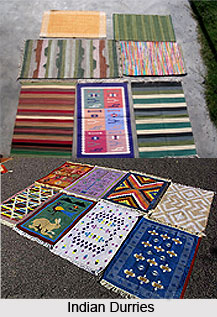
 Durrie is a thick flat-woven rug or carpet used traditionally in India as floor-coverings.The concept of durrie is different from a rug or carpet, but since the durries serve the same purpose as carpet or rugs they can be described as one. Durries as the name suggests do not have knots and are without any pile. Due to this distinctive facet, Durries can be used both ways as these are reversible too. This unique feature is the hallmark of the functionality of these multipurpose rugs. Being reversible, durries require less washing. Durrie is a thick flat-woven rug or carpet used traditionally in India as floor-coverings.The concept of durrie is different from a rug or carpet, but since the durries serve the same purpose as carpet or rugs they can be described as one. Durries as the name suggests do not have knots and are without any pile. Due to this distinctive facet, Durries can be used both ways as these are reversible too. This unique feature is the hallmark of the functionality of these multipurpose rugs. Being reversible, durries require less washing.
Creation of Durries Durries are completely hand-made, hand-woven in various regions in India. Durries today are being made in a variety of hand-spun natural fibers such as wool, cotton, hemp, sisal and blends of wool or hemp as well. Durries are made in wide ranging designs inspired from Tribal motifs and culture of the bygone era and are also available in contemporary, minimalist styles that are full of verve and eclectic ethos. A typical time frame for a Durrie is 9’x6’ in size which takes 8 weeks time to be made. This material is first converted into thread and then woven into durries. The tools that the weaver uses are simple and these have remained unchanged with time. History of Durries in India Durrie weaving in India has been a cottage industry for many centuries, historically in many small villages and towns of Uttar Pradesh. The families and weavers behind stunning durries are talented and committed and have been weaving for 100 years with their skills and knowledge gradually being passed down from one generation to the next. Weaving has traditionally been a ‘village industry’ in India and was once considered a major life source to a village, providing income, occupation and creativity. Apart from this, during late 19th and early 20th centuries, the prisoners in Indian jails worked arduously on this cottage craft creating spectacular narrative durries. These durries would have sceneries depicting village activities, natural flora and fauna. A large number of landless weavers were sustaining themselves on Durrie weaving. Durries of Different Regions  Floor coverings have always been an important part of the interior of home in India, the use of furniture being very limited. Weaving of durries in various designs, especially by the young Punjabi girls has been a long tradition in Punjab. This handicraft still has an undoubted importance in Punjabi art. The cotton durries of Rajasthan are traditionally produced in resplendent colours, adding a dash of energy to the room. The durries are known to have a long life, lasting a couple of decades if maintained on a regular basis. Haryana has today emerged as a major carpet producing center, as a result of long years of research and practice.
The technique of durrie weaving can be seen in its most primitive form in the villages of Rajasthan, Punjab and Haryana where girls are normally put to the task at an early age so that they can prepare rugs that will form part of their trousseau. In contrast, girls in Navalgund, a village in Karnataka that produces a small number of unusual durries, are never taught the craft lest they spread the skill outside the family after marriage. Fine durries in brilliant colours made of cotton and silk have become a speciality of Salem (Tamil Nadu) while those made of jute fibre are woven in West Bengal. Madhya Pradesh durries are known for their sturdy character and delightful colours. Rajasthan, Uttar Pradesh, Punjab and Himachal Pradesh, make distinctive type of durries. In some part of these states the durries make a part of dowry given at the time of a daughter's marriage. Durries made in Rajasthan at Salawas are known as Panja durries and are exported on large scale. Khairabad in Uttar Pradesh is a major durrie making centre. Designs and Patters of Durries Durries come in numerous designs although the most common are stripes of different colours and geometrical designs. The kinds of patterns created in durries are varied. Sometimes animal and bird motifs are also used. Geometrics, honey combs, waves, peaks, basket weaves and chic floral motifs are some of the popular design styles in Durries. "Panja Durries" with floral, geometric, bird and animal motifs are especially attractive. The striped Durrie is the quintessential Indian feature over rug. Blue and white striped durries were known by their literal translation such as "nili chithi" meaning blue spot and "nili pattidar" meaning the simple blue stripped durrie. The colours used in durries generally come in bold, striking, colourful designs with simple, geometric or symmetrical, and often repetitive or Mughal inspired patterns. Not only are they used as indoor floor coverings but, due to their versatility, over the years, they have also come to be used as wall hangings, bedding, packing material and table covers. These are interpreted in a multitude of fresh colours depending on an individual preference. |
| |||



Indian Durries
| Durrie weaving has been a cottage industry for many centuries in India. |
| ||||||||||||||||||||||||||||

