


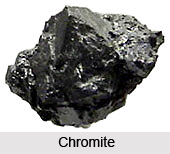
 Chromium is an important metal and has a wide range of industrial uses. Chromite forms in deep ultra-mafic magmas and is one of the first minerals to crystallize. It is because of this fact that chromite is found in some concentrated ore bodies. While the magma is slowly cooling inside the Earth's crust, chromite crystals are forming and because of their density, fall to the bottom and are concentrated there. Although its primary origin is ultra-mafic rocks such as peridotites, chromite is also found in metamorphic rocks such as serpentites. Chromium is an important metal and has a wide range of industrial uses. Chromite forms in deep ultra-mafic magmas and is one of the first minerals to crystallize. It is because of this fact that chromite is found in some concentrated ore bodies. While the magma is slowly cooling inside the Earth's crust, chromite crystals are forming and because of their density, fall to the bottom and are concentrated there. Although its primary origin is ultra-mafic rocks such as peridotites, chromite is also found in metamorphic rocks such as serpentites.
Chromite, as is indicated by its early crystallization is resistant to the altering affects of high temperatures and pressures. Thus it is capable of going through the metamorphic processes unscathed, while other minerals around it are being altered to serpenti, biotite and garnets. This characteristic also explains chromites use as a refractory component in the bricks and linings of blast furnaces. Usually magnesium is present in chromite substituting for the iron and in fact a solid solution series exists between chromite and the much rarer mineral magnesiochromite. All chromite specimens in nature contain some magnesium; likewise all natural magnesiochromites contain some iron. Magnesiochromite is grayer in color and in streak and has a slightly lower density than chromite at a specific gravity of 4.2 to 4.4. Characteristics of Chromite Chromite comes in dark brown to black mineral. It is an iron-chromium oxide, with traces of magnesium and aluminum. Its crystals are octahedral, but rare; it usually occurs as irregular, granular masses in association with igneous rocks, including ophiolites, which are segments of oceanic crust exposed on land by tectonic processes usually associated with plate convergence plate tectonics. Chromitite is an igneous rock composed chiefly of the mineral chromite. The only commercial source of chromium and its compounds, chromite is used in the manufacture of refractory materials. Chromite has a variety of uses. Chromium is extracted from it to make stainless steel and other alloys for which resistance to oxidation and corrosion is important. Chromium is also used as plating and tanning agent. The mineral chromite is made into refractory lining for steel-making furnaces. |
| |||



Indian Chromite Mines
| Chromite is the most important ore of chromium from which it derives its name. |
| ||||||||||||||||||||||||||||

