History of Khasi Tribe
|
In the mid-sixteenth century there were twenty-five separate Khasi chiefdoms along with the separate kingdom of Jaintia.
|
|
|
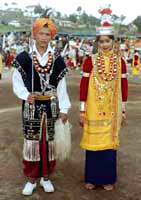 Before the arrival of the British, from the thirteenth to the eighteenth centuries, the Jaintia dominated a large number of kingdoms. At the beginning of the sixteenth century Jaintia rule was extended to Sylhet and this marked the beginning of Brahman influence on the Jaintia. By 1860, the British had annexed all of theJaintia Hills region and imposed taxes on it as a part of British India. Before the arrival of the British, from the thirteenth to the eighteenth centuries, the Jaintia dominated a large number of kingdoms. At the beginning of the sixteenth century Jaintia rule was extended to Sylhet and this marked the beginning of Brahman influence on the Jaintia. By 1860, the British had annexed all of theJaintia Hills region and imposed taxes on it as a part of British India.
The Khasi states had limited cultural relations before the arrival of the British, characterized in large part by internal warfare between villages and states. The incorporation of the markets at Sylhet into the British colonial economy in 1765 marked the beginning of Khasi subjugation. In 1837 the construction of a road through Nongkhaw State linking Calcutta to the Brahmaputra Valley led to the eventual cessation of Khasi-British hostilities, and by 1862 treaties between the British and all of the Khasi states (allowing Khasi autonomy and freedom from British taxation) were signed. This showed a significant amount of cultural change like an increase in wealth, decline of traditional culture, rise in educational standards, and frequent intermarriage. The Khasis now have their own state, Meghalaya, in which they predominate.
Khasi villages are built a little below the tops of hills in small depressions to protect against storms and high winds. Their houses are built in close proximity to one another. In addition to individual houses, family tombs and memorial stones called mawbynna are located within their territory. There is no internal division of the village based on wealth; rich and poor live side by side. Sacred groves are located near the Village between the brow of the hill and the leeward side, where the village's tutelary deity is worshiped. Pigs wander freely through a village, and some villages (e.g., those of the high plateau) also feature potato gardens protected by dry dikes and hedges. Narrow streets connect houses and stone steps lead up to individual houses. The upper portion of a Khasi Village may be as much as 100 meters higher in elevation than the lower portion.
The typical Khasi house is a shell-shaped building with three rooms: the shynghup is a porch for storage; the nengpei is the center room for cooking and sitting ; and the rumpei is the inner room for sleeping . The homes of wealthy Khasi are more modern, having iron roofs, chimneys, glass windows, and doors. Some have European-style homes and furniture. A marketplace is located outside a Khasi village (close to memorial stones, by a river or under a group of trees, depending on the region). Within Khasi villages one may find a number of public buildings, Christian churches, and schools.
|
|
|
|





