


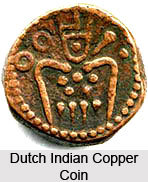
 Copper dump coins were issued by the Dutch Mint in Negapatnam, in Coromandel (south-east Indian coast) for circulation in Lanka. On 1658 July 23, the Dutch took Negapatnam from the Portuguese. In 1662 it was granted the half Mint Custom by a concession of the Nayak of Tanjore. From 1673 to 1680 it was under the Government of Ceylon. Copper dump coins were issued by the Dutch Mint in Negapatnam, in Coromandel (south-east Indian coast) for circulation in Lanka. On 1658 July 23, the Dutch took Negapatnam from the Portuguese. In 1662 it was granted the half Mint Custom by a concession of the Nayak of Tanjore. From 1673 to 1680 it was under the Government of Ceylon.
In 1690 the head office for the Coast of Coromandel, moved in from Pulicat until in 1784 the Dutch were forced to hand it over to the British. Two varieties of Copper coins are available from Negapatnam. The older coins figure of goddess Kali, which were minted for circulation in Ceylon, described below, and coins with N above the VOC monogram issued for circulation within the limited area of the Company. Although they bore the name Negapatnam on the reverse they were intended principally for Lanka. Goddess Kali known also as Durga and as Chandi [the Fierce], Kali is associated with disease, death, and destruction. As Parvati she is the consort of Shiva. Although often represented as a terrifying figure, garlanded with skulls and bearing a bloody sword in one of her many arms, many as the Divine Mother worship her lovingly. VOC Kas copper coins were issued by the Dutch Mint in Paliakate in Coromandel (south-east Indian coast). They are found in Lanka. Paliakate was the VOC head office of the Coromandel since its establishment in 1610 to 1690 when Negapatnam superseded it. From 1781 to 1784 all the settlements on the coast were in British hands and in 1784 Negapatnam having been ceded to the British, Paliakate again became the head office until occupied again in 1795. Fort Gelria established in 1615 was the first VOC mint in India. Initialy copper coins with VOC monogram and a Sanskrit legend were struck. In 1646 the Dutch received permission from the Golconda Sultan Abd Allah Qutb Shah to strike coins at Paliakate "with the stamp of the King of Golconda" The inscription degenerated through the years and the word Allah, which was a wavy line in the beginning, became due course completely omitted. The small copper coins were current only within the limited area of the Company. Few of the 1-kas coins have a metallic tone more lead-like than copper. The coins don't have any markings, which indicate the denomination. They however divided into two well-separated weight groups. The gulden was the currency of the Netherlands Indies until 1949. It was equal to the Dutch gulden for most of its existence. |
| |||



Home > Reference > Indian Administration > Indian Coins > History of Indian Coins > Coins of Modern India > Coins during British India > Dutch Indian Coinage
Dutch Indian Coinage
| Copper dump coins were issued by the Dutch Mint in Negapatnam. |
| ||||||||||||||||||||||||||||

