 Danish India is a term for the former colonies of Denmark in India. The Danish East India Company was established in 1616 and a Danish settlement was established at Tranquebar in 1620. There was also a Danish settlement at Serampore near Calcutta. They were more important for the missionary activities carried on there than for commerce. In 1779 it was turned over to the government by the chartered company and became a Danish crown colony. In 1789 the Andaman Islands become a British possession. During the Napoleonic Wars, the British attacked Danish shipping, and devastated the Danish East India Company`s India trade.
In June 1801 the Danish were defeated at Tranquebar by the Scots Brigade and in 1845 the whole Danish colony was sold to England. This ended the Danish presence in India.
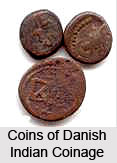
The Danes got their main trading post in India on the Coromandel Coast, at the delta of the Cauvery River in 1620. The only mint in the Danish settlements was in Tranquebar. The Christian IV Danish coin had on the reverse, Iupter, name of a ship of the Danish East India Company which arrived at Tranquebar on 15th March 1624 and was wrecked off the coast of Bengal in 1625. It also had, on reverse, St Iacob, name of a ship of the Danish East India Company, which arrived at Tranquebar on 3rd September 1636 and was wrecked in the Bay of Bengal in 1640.
The entwined VOCD, monogram was copied from that of the VOC, the Dutch East India Company, with an added D for "Dansk" (Danish). Christian V coin had "DC" on the reverse stands for D (ansk Ostindisk) C (ompagni), the Danish East India Company chartered by Christian IV in 1616 which administered Tranquebar until 1729, when it succumbed to its debts. There were silver as well as copper coins of different denominations. Since 1778, after the revision of the charter of the DAC, Tranquebar became a colony of the crown. The coinage was changed accordingly and the monogram of the company disappeared from the coins.
The Danish Indian rupee was the currency of Danish India. It was subdivided into 8 fano, each of 80 kas. In 1845, Danish India became part of British India and the local rupee was replaced by the Indian rupee.