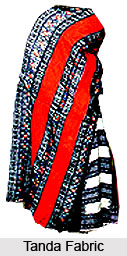
 Origin of Tanda is associated with Emperor Akbar, who named it "Tanda" on the name of the local banjaras. Katwas and julahas from Banaras settled here in early 16th century. In 18th century agents of East India Company, established a trading centre here.
Designs and Patterns of Tanda
The motifs are mostly floral, arranged in plain, satin diagonal (ari), and in the form of a net (jaldar). Some of the local floral motif names are Chameli, Mogra, Juhi, Khas Pomera, Hassingar. Animals or bird motifs are not usually seen.
Some of the designs commonly used are:
•Aribel (figures arranged diagonally);
•Laharin (wavy lines and figures arranged in wavy lines);
•Kharibel (figures arranged vertically);
•Jaldar (figures arranged in the form of a net);
•Phuldar (floral leaves arranged in a creeper form);
•Isqapench (fine leaves arranged in a creeper form);
•Patri (horizontal running figures);
•Jal Guldasta (roses and leaves alternating within the ornamental network);
•Phul Annanas (pineapple motif).
Procedure of Tanda
100s count cotton yarn is used for warp and the yarn used is always grey. The main weft is usually of 120s count while the figuring weft is 2 ply untwisted of 100s count. The weave is plain. The loom is a very simple throw shuttle pit loom with treadles. No jacquard, dobby machine or jala is used for figure weaving. Throw shuttle and the figure weft lay the ground weft by tillies. The order for laying weft is; one for ground with shuttle and one for figure with tillies. The ground weft is beaten into the cloth and then the shade is changed. The tillies for figure wefts are as many as there are figures along the width of the cloth. The ground weft is allowed to lie loose in the shade while the tilli work is done. When tilli work is completed, the loose ground weft is beaten into the cloth along with the figure weft and the shade is changed again for tilli work. In plain portions, weaving is done only with shuttles. The twill tapestry technique of weaving is generally used, with the weft threads alone forming the pattern and they do not extend over the full width of the cloth. The threads of ornamentation are usually cut at both edges after the figure is completed. The weaver usually weaves the motifs from memory and does not use any graph or design.
Toda Woven
The intricate design work is carried out adjacent to the red or black band and extensively parallel to them with same geometrical or floral or zigzag patterns. The designs are symbolic. The most important is the buffalo horn as Todas worship the buffalo. A very beautiful design is of their little box called "Mettvi Kanpugur". One design has been named after one of their ancient praises Izhadvinpuguti, but several after the wild flowers that cover their mountain sides. A touching one is "Resdazhpugar", named after a girl who slipped and fell off a precipice, perpetuate her memory.
Procedure of Toda Woven
They call it Pugur which means flower. Geometrical in pattern, the stitching is done on the long shawls called Poothkuli, is specially woven for them and carries the embroidery at the length, thick red and black bands at intervals of 6 inches. The stitches are worked thick and close together in red and black thread counting the weft, so that the total effect is one of an embossed weave. The requisite patterns are woven without any sketch.