


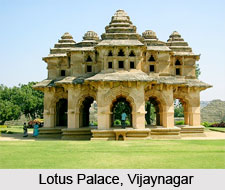
 The monarchs of the Vijayanagara empire sustained the smooth functioning governmental methods developed by their precursors, the Hoysala, Kakatiya and Pandya kingdoms, to govern their territories and made changes only where necessary. The King was the eventual power, backed by a cabinet of ministers (Pradhana) headed by the prime minister (Mahapradhana). Further important titles recorded in inscriptions were the chief secretary (Karyakartha or Rayaswami) and the imperial officers (Adhikari). All high-ranking ministers and officers were obligatory to pursuemilitary training. The monarchs of the Vijayanagara empire sustained the smooth functioning governmental methods developed by their precursors, the Hoysala, Kakatiya and Pandya kingdoms, to govern their territories and made changes only where necessary. The King was the eventual power, backed by a cabinet of ministers (Pradhana) headed by the prime minister (Mahapradhana). Further important titles recorded in inscriptions were the chief secretary (Karyakartha or Rayaswami) and the imperial officers (Adhikari). All high-ranking ministers and officers were obligatory to pursuemilitary training.
A secretariat in close proximity to the king's palace employed scribes and officers to maintain records made official by using a wax seal imprinted with the ring of the king. At the lower administrative levels, wealthy feudal landlords (Goudas) supervised accountants (Karanikas or Karnam) and guards (Kavalu). The palace administration was divided into 72 departments (Niyogas), each having several female attendants chosen for their youth and beauty (some imported or captured in victorious battles) who were trained to handle minor administrative matters and to serve men of nobility as courtesans or concubines. The empire was separated into five main provinces (Rajya), each under a commander (Dandanayaka or Dandanatha) and headed by a governor, habitually from the royal family, who used the native language for administrative purposes. A Rajya was divided into regions (Vishaya Vente or Kottam), and further divided into counties (Sime or Nadu) themselves subdivided into municipalities (Kampana or Sthala). Hereditary families ruled their respective territories and paid tribute to the empire while some areas, such as Keladi and Madurai, came under the direct supervision of a commander. 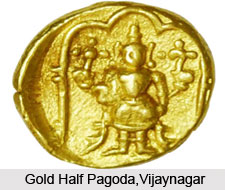 On the battlefields, the king's commanders led the troops. The empire's war strategy rarely involved massive invasions; more often it employed small-scale methods such as attacking and destroying individual forts. The empire was among the first in India to use long-range artillery commonly manned by foreign gunners. Army troops were of two types: The king's private army unswervingly recruited by the empire and the feudal army under each feudatory. King Krishnadevaraya's personal army consisted of 100,000 infantry, 20,000 cavalrymen and over 900 elephants. On the battlefields, the king's commanders led the troops. The empire's war strategy rarely involved massive invasions; more often it employed small-scale methods such as attacking and destroying individual forts. The empire was among the first in India to use long-range artillery commonly manned by foreign gunners. Army troops were of two types: The king's private army unswervingly recruited by the empire and the feudal army under each feudatory. King Krishnadevaraya's personal army consisted of 100,000 infantry, 20,000 cavalrymen and over 900 elephants.
This number was only a part of the army numbering over 1.1 million soldiers, a figure that varied as an army of two million has also been recorded along with the existence of a navy as evidenced by the use of the term Navigadaprabhu (commander of the navy). The army recruited from all classes of society (sustained by the compilation of additional feudal tributes from feudatory rulers), and consisted of archers and musketeers wearing quilted tunics, shield men with swords and poi nards in their girdles, and soldiers carrying shields so larges that no armor was necessary. The horses and elephants were fully armored and the elephants had knives fastened to their tusks to do maximum damage in battle. The capital city was completely dependent on the water supply systems constructed to channel and store water, and guarantees a steady supply throughout the year. The remains of these hydraulic systems have given historians a picture of the prevailing surface water distribution methods in use at that time in South India's semiarid regions.[37] Contemporary inscriptions and notes of foreign travelers describe how labourers constructed huge tanks. 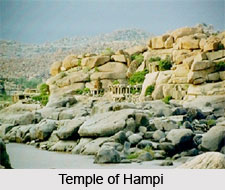 Excavations have revealed the remains of a well-connected water distribution system accessible exclusively within the majestic inclusion and the large temple complexes (suggesting it was for the exclusive use of royalty, and for special ceremonies) with sophisticated channels using gravity and siphons to transport water through pipelines. Excavations have revealed the remains of a well-connected water distribution system accessible exclusively within the majestic inclusion and the large temple complexes (suggesting it was for the exclusive use of royalty, and for special ceremonies) with sophisticated channels using gravity and siphons to transport water through pipelines.
The only structures akin to public waterworks are the remains of large water tanks that collected the seasonal monsoon water and then dried up in summer except for the few fed by springs. In the fertile agricultural areas near the Tungabhadra River, canals were dug to guide the river water into irrigation tanks. These canals had sluices that were opened and closed to control the water flow. In other areas the administration encouraged the digging of wells monitored by administrative authorities. Large tanks in the capital city were constructed with royal patronage while wealthy individuals; in order to attain social and religious merit funded smaller tanks. |
| |||



Home > Reference > History of India > History of South India > Aravidu Dynasty > Administartion of Aravidu Dynasty
Administartion of Aravidu Dynasty
| The Aravidu Dynasty`s palace administration was divided into 72 departments. |
| ||||||||||||||||||||||||||||

