


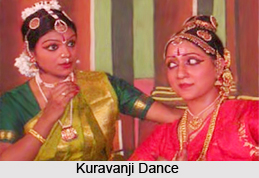
 Kuravanji dance is performed in the Tamil Nadu state of India. It is said that like the Bhagavatha Mela, Kuravanji dance form of Tamil Nadu is also a cross over dance from Andhra Pradesh. The word "Kura" refers to the tribe 'Kuruvas' or 'Chenchus', where the men were the nomadic hunters of Andhra Pradesh, whereas their women folk were reputed fortune-tellers. The word "Anji" is derived from adavus, which means traditional dances. The form is also referred to as kuram and kuluva natakam. Kuravanji dance is performed in the Tamil Nadu state of India. It is said that like the Bhagavatha Mela, Kuravanji dance form of Tamil Nadu is also a cross over dance from Andhra Pradesh. The word "Kura" refers to the tribe 'Kuruvas' or 'Chenchus', where the men were the nomadic hunters of Andhra Pradesh, whereas their women folk were reputed fortune-tellers. The word "Anji" is derived from adavus, which means traditional dances. The form is also referred to as kuram and kuluva natakam.
History of Kuravanji Dance It is believed that this art originated in the 17th century and has an identity of its own. The earliest patron of this was King Rajaraja Chola, who constructed a big platform at Thanjavur for holding Kuravanji performances during the annual festival, Kuravanji Medai. In its actual terms, the Kuravanjis were regularly performed in temples and the artistes kept them ready for performance. But due to the prohibition of the dancing of the devadasis in temples, the practice of performing Kuravanjis, also declined slowly. Performance of Kuravanji Dance Lord Vighneswara (Ganapati, the elephant-headed god) is the presiding deity for its performance. As the play starts, it depicts the story of Kuravanji. After the salutary procession, the kattiakaran summarizes the story, which in fact is a variation on one theme that runs through all performances. The framework of the dance performance of Kuravanji provides an ideal medium for projection of geography lessons and was utilized skilfully for the same purpose by Maharaja Serfoji II (1798- 1833). In addition to the gypsy women, singers, instrumental musicians and dancing girls are also added to the art. Types of Kuravanji Dance There are hundreds of Kuravanjis performed all over the state. Compositions like the 'Thirukkutrala Kuravanji are famous for their fluent poetic importance. The Viralimalai Kuravanji is recognized for its musical value. In the Azhagar Kuravanji and the Thirumalai Andavar Kuravanji, a wonderful balance is maintained between music and literature. The Sendil Kuravanji is a dance-drama centering around the theme of the presiding deity of Tiruchendur, where the heroine Madana Mohini appears on the scene. Spending her time in the delightful company of her friends, she sees Lord Arumuga coming in procession and falls in love with him. |
| |||



Home > Art & Culture > Indian Dances > Folk Dances of Indian States > Folk Dance of Tamil Nadu > Kuravanji Dance
Kuravanji Dance
| Kuravanji dance is performed in the Tamil Nadu state of India. It is believed that this art originated in the 17th century. |
| ||||||||||||||||||||||||||||

