


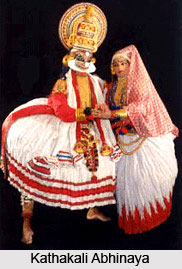
 Style in Kathakali is virile and masculine in nature. Kathakali is a dramatic performance in which the actors interpret their emotions through highly sensitive medium by its vivid and persuasive mudras, natural and impressive gestures, graceful and rhythmic movements, pleasing choreography and delightful imagery. Kathakali is predominantly a male art. The major original Kathakali styles included Vettathu Sampradayam, Kalladikkodan Sampradayam and Kaplingadu Sampradayam. The different styles of Kathakali have narrowed down to the northern and southern styles. It is the highly stylised northern tradition that is implemented in Kerala Kalamandalam.
The position taken by the actor is angular and his knees are spread out and his legs form a rhombus. He maintains a balance although his outer feet are not flat on the ground. His hands are bent at the elbow and his palms are placed on his hips. The female character however, is gentle and grateful which is evident in the love scenes. The acting mode of Kathakali can be better understood in terms of four-fold scheme of historic representation given in the Natyashastra. They are: actor and included an elaborate scheme of facial expression, mime and gestures, accompanied by their appropriate movements, poses and attitudes. Dance passages known as Kalasams have an important role to play in Kathakali. While sustaining as a pure dance, it also enhances the appropriate Bhavas. Hand gestures are another integral part of Angika as the interpretation of the text is conveyed through them. Hastalakshna Deepika is the regional text on the Hasta Mudras which is used in Kathakali. 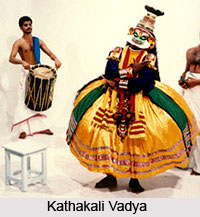 The actors do not speak and the drama text in the form of verses and songs are recited and sung by vocalists. This is known as Vachika Abhinaya. These songs are interpreted in details by actors through an elaborate method of angikabhinaya. The vocal music in Kathakali is based on the Carnatic music; it has developed a distinct regional style called Sopanasangeetham. It evokes appropriate dramatic mood and sentiments.
A highly stylized technique in the invocation of bhava has been developed in Kathakali, which is the Rasabhinava. Natyashastra lists another set of eight moods called Satvika Bhavas, which is more subtle and involuntary as compared to Angikabhinaya. Through an internal discipline an actor develops his ability in mastering this action technique. This helps the actor to go deeper into the characterization of the role in proper situation in the play. This is termed as Satvika Abhinaya. The make-up and costuming is very important in Kathakali. The characters in Kathakali are classified according to the colour they have used on their faces. The classical elements of this art form comprise Natya, Nritta, Nritya, Geetha and Vadya. Kathakali is appreciated and understood with an understanding of Mudras. The actors in a sense translate background music into dance and drama. A story is frame-worked within an intricate array of lyrics and poems. Kathakali characters communicate with each other through a sophisticated language, body movements and facial expressions, which include about 600 to 700 gestures. There is also a complete control of the eyeballs and the different muscles in the face, so that the different emotions could be expressed and exhibited in a superb manner. Intensive physical training and oil massaging of the body gives it the complete flexibility and control of the body. A Kathakali actor uses immense concentration, skill and physical stamina, gained from the training based on Kalari Payattu, the ancient martial art of Kerala, to prepare for the demanding role of a Kathakali actor. |
| |||



Home > Art & Culture > Indian Dances > Classical Dances of India > Kathakali Dance > Style And Techniques of Kathakali
Style And Techniques of Kathakali
| Styles of Kathakali differ from each other in choreographic profile, hand gestures and stress on dance than drama and vice versa. |
| ||||||||||||||||||||||||||||

