


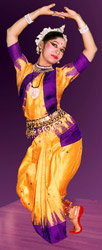
 Technique of Odissi dance includes elements of Lasya and Tandava. The Tandava element was incorporated into the Odissi dance from the Shaiva School of dancing which had flourished during 8th to 10th century A.D. The technique is based upon the "Chowka", a manly posture, and the weight of the body is distributed equally on both the sides. It is the posture of Lord Jagannath of Puri and reflects the balanced, all-encompassing and universal quality of "Dharma". In the "Abhanga" position, the body weight is displaced to any one side due to deflection of one or the other knee, in either standing or half sitting posture. Technique of Odissi dance includes elements of Lasya and Tandava. The Tandava element was incorporated into the Odissi dance from the Shaiva School of dancing which had flourished during 8th to 10th century A.D. The technique is based upon the "Chowka", a manly posture, and the weight of the body is distributed equally on both the sides. It is the posture of Lord Jagannath of Puri and reflects the balanced, all-encompassing and universal quality of "Dharma". In the "Abhanga" position, the body weight is displaced to any one side due to deflection of one or the other knee, in either standing or half sitting posture.
Tribhanga in Odissi The human body is divided into three bhangas along which deflections of the head, torso and hips can take place. The technique is built on the principle of an unequal division of weight and the shift of weight from one foot to the other. The movement of the head, the torso, the hips and the knees, are important. Hip deflection is the characteristic feature of this dance style. The dvibhanga is highly emphasized here. The tribhanga is one of the most typical poses of Odissi dancing. The tribhanga is evolved by one half of lower body remaining static along the central plumb line while the other leg usually crosses the first. Half of the body from the torso upwards deflects in the opposite direction. The head or neck provides the third deflection. The tribhanga is achieved by a sharp deflection of the hip from the horizontal Kati sutra, and the head deflecting to the same side as the hip. It is an extremely feminine posture represented in sculptures of female figures and is based upon the Hindu concept of iconography. The bends are made at the knees, the torso and the neck. This posture and the characteristic shifting of the upper body from side to side, make Odissi a difficult style to execute. Foot Movement in Odissi 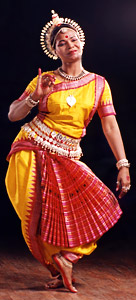 Foot contacts resemble those of Bharatnatyam. Here both the fiat foot and the toe-heel contacts are employed. The toe touching the ground (kunchita) and the heel stamping the ground are movements of Natyashastra which are used repeatedly. There is a rare use of the combined toe-heel movement in the kuditta mitta sequences. There are extremely complex rhythmic sequences based on the use of the heel. Odissi has also a peculiar movement in which the dancer moves on the heels alone and this is done during the ending of a dance piece and always precedes tihai or the final beats. In this movement the dancer jumps forward and moves on the heels round his person or recedes back to take a final step. Foot contacts resemble those of Bharatnatyam. Here both the fiat foot and the toe-heel contacts are employed. The toe touching the ground (kunchita) and the heel stamping the ground are movements of Natyashastra which are used repeatedly. There is a rare use of the combined toe-heel movement in the kuditta mitta sequences. There are extremely complex rhythmic sequences based on the use of the heel. Odissi has also a peculiar movement in which the dancer moves on the heels alone and this is done during the ending of a dance piece and always precedes tihai or the final beats. In this movement the dancer jumps forward and moves on the heels round his person or recedes back to take a final step.
Some of the other forms of dance which are used by the Odissi dancers are Arasas, Belis and Palis. Arasas is the next unit comprising of the khandis. The khandis are used in various combinations and permutations to form Arasas. It begins with the smallest unit, combinations are made of words and phrases and then sentences; all contained within the parameters of the metrical cycle. Khandis and Arasas are used to form dances sequences called the Belis and Palis. Belis are longer sections of Nritta whereas the Palis are the finale sequences, which are in triplets like the tihais in Bharatnatyam. Minadandi: This involves a semicircular walk or the covering of space by one leg more specifically the calf in semicircles, returning back to centre. The other half of the body is static. Other foot or leg repeats the same. Ghera: Ghera involves covering of space in circles, half circles, semi-circles and concentric circles. These are the movements emerging from Tribhangi, Baitha and Chauka. There are various movements, which arise out the Tribhangi keeping one half of the body static and the other leg extending in different directions like back, front and sides. In movements emerging from Baitha, one foot and knee are in contact with the ground whereas the other leg is extended to the side or back. In movements emerging from Chauka, the feet are static and only the torso can move or a complete pirouette can be executed holding the chauka position. Bhramaris: Bhramaris are the spins and the pirouettes executed from the three positions: Tribhangi, Samapada and Chauka, both clockwise and anti-clockwise. There are various Bhramaris depending on their foot contact at the initial position and the final movement of elevations of the knee and the direction of the pirouettes. Hasta Mudras or Hand gestures play an important role in any kind of dance. They are used as decorative embellishments and in Odissi Hasta Mudras are used as means of communication. The dancer uses the hands to express emotions in a more vivid manner. |
| |||



Technique of Odissi
| Technique of Odissi dance follows the basic rules of the Natyashastra and the Silpasastra. |
| ||||||||||||||||||||||||||||

