 Necklaces
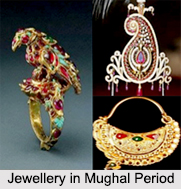
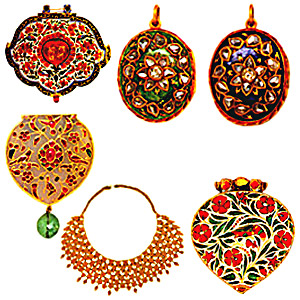
This is an enamelled gold and silver pendant set with rubies, emeralds, natural white sapphires and rock crystal, strands of pearls and emerald with two rubies. Necklaces like this could have been made at almost any time in the eighteenth and nineteenth centuries. However, the crowded effect of the red, white, blue and green motifs on the back of the pendant suggests 19th century decadence when compared with the unobstructed designs of 18th century pieces.
This necklace is full with enamelled gold plaques and pendants, some set with pendent pearls and green glass beads, whereas the strands of pearls terminate in emerald and ruby beads. Each of the large central pendants is enamelled with slightly different motifs using the same red, white and green palette, highlighted with touches of pale blue. The plaques, which secure the strings of pearls, are enamelled in an unusual combination of opaque yellow and white flowers with lime green leaves on a translucent ground.
This Necklet is enamelled in gold, set with diamonds and pearls, with pendent pearls and emeralds. This was acquired by the Indian Museum in 1855.
This is an enamelled gold set with diamonds, with strands of pearls, rubies and green glass. Like the preceding necklet, this was acquired by the Indian Museum in 1855; both were almost certainly exhibition pieces.
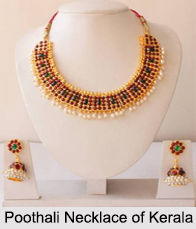
Another necklace had gilt metal beads and pendants on red silk. Caspar Purdon Clarke acquired this on his tour of India in 1881-82.
This Filigree necklace is a gold wire with stamped florets and applied flat discs and hemispheres. This extremely fine necklace was bought from the 1851 Great Exhibition as `modern` work from Calicut.
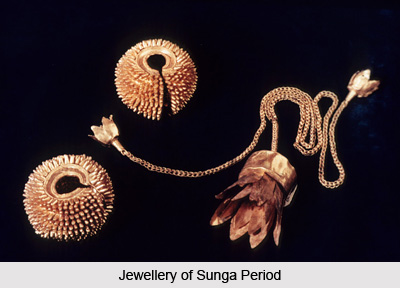
This necklace has beads of gold wire, with applied granulation and minute flat discs, with gold links. Each of the 144 beads on this necklace has three levels, a central rosette of flat wires and triangular groups of granules at the apex of each alternate petal. Overlaid on this, at front and back, is another rosette with minute flattened discs on the tips of the petals.
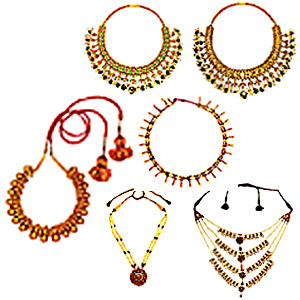 This necklace has interlinked gold pendants on doubled gold chain. Each pendant is stamped out from a flat sheet of gold with applied twisted wires and granulation at the front. The pendants interlink by means of rings running through their four loops. The lower edge of the necklace has pendent filigree vases, many now missing.
Pendants & Lockets
This pendant (taviz) is a white nephrite jade in a pierced gold frame, set with rubies and emeralds in gold and with a pendent emerald, the back inscribed and set with a ruby in gold. The palmette at the centre relates to those found in the Iranian-influenced decorative arts of the late 16th and early 17th centuries, rather than to the period of Shah Jahan when floral decoration became more naturalistic. The detail is painstaking, with the eyes of the birds being minute emeralds set in gold. The back is inscribed with a Koranic verse. The amulet, which is bored along the top edge, would have been the central pendant to a necklace.
This pendant is enamelled gold, set with rubies and a diamond on the front, and with green glass imitating emeralds. This pendant, with its carefully shaped, flat-set rubies, and green glass imitating emeralds, is worked in a style, which goes back to the late 16th century. The gemstones are used almost like mosaics, set into chased depressions and separated by gold left in slight relief to delineate the pattern. The residual areas are then engraved with flowers and foliage. The back is beautifully enamelled in a rhythmic portrayal of a bird amongst flowers, using the standard Moghul palette of white, red and green, though with touches of opaque yellow and blue.
These lockets are the enamelled gold set with diamonds. Each locket has a rose-cut diamond at its centre, the other stones being roughly faceted and a rather unusual feature in Indian jewellery where small diamonds are, typically, flat-cut. The larger of the two lockets has translucent blue at the front, the smaller and a rather pale translucent green. The backs have similar motifs of red, green and blue birds and flowers on a white ground, on the larger contained within a quatrefoil frame and on the smaller within an oval.
Pilgrims to the shrine of Shrinathji at Nathdvara in Rajasthan would have worn this pendant (Latkan). Shrinathji appears on one side in a heart-shaped cartouche of translucent red enamel, surrounded by red, blue and green peacocks and flowers on a white ground. On the other the vishnupada is also seen, the feet adorned with symbols such as the svastika, the auspicious symbol known from ancient times in the subcontinent.