


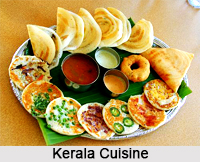
 The delicious Kerala cuisine is one of Kerala's popular attractions. The food of Kerala is traditionally served on a banana leaf and almost every dish has coconut and spices added for flavour, giving its cuisine a sharp pungency that is heightened with the use of tamarind. The cuisine of Kerala is characterized by the use of coconut, either chopped or grated and used as garnishing, coconut milk or paste is used to thicken gravies and coconut oil is used for cooking. Though one cannot imagine Kerala food without chillies, curry leaf, mustard seed, tamarind and asafoetida. The delicious Kerala cuisine is one of Kerala's popular attractions. The food of Kerala is traditionally served on a banana leaf and almost every dish has coconut and spices added for flavour, giving its cuisine a sharp pungency that is heightened with the use of tamarind. The cuisine of Kerala is characterized by the use of coconut, either chopped or grated and used as garnishing, coconut milk or paste is used to thicken gravies and coconut oil is used for cooking. Though one cannot imagine Kerala food without chillies, curry leaf, mustard seed, tamarind and asafoetida.
Kerala is known as the "Land of Spices" because it traded spices with Europe as well as with many ancient civilizations with the oldest historical records of the Sumerians from 3000 BC. Various locally available vegetables such as tapioca, cassava and yam form part of the cuisine of Kerala. Bananas and coconuts are available year round and is a staple diet in Kerala. The refreshing juice of the tender coconut is a delightful drink, which can be enjoyed on Kerala tours with Kerala Backwater. Breakfast Items of Kerala Cuisine The breakfast dishes include "Puttu" and "Kadala", "Idli", "Sambar", "Dosa" and "Chutney", "Idiyappam", "Paal-Appam". Idiyappam and Paal-Appam are had with vegetable stew or curry. Other items include "Upma", "Chapati" and so on. 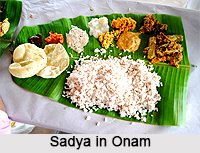 Lunch and Dinner Items of Kerala Cuisine Lunch and Dinner Items of Kerala Cuisine
"Rice" is had during the lunch. Parboiled rice is preferred by the Keralites. "Kanji", a kind of rice porridge is also well-liked. Rice is accompanied with one or more curries. It includes sautéed vegetables or "Uperi", "Rasam", buttermilk or simply curd, "Kalan" or "Parippu Curry". Vegetarian dishes include "Sambar", "Avial", "Thoran", "Puliserry", "Olan", "Eriserry", "Pulinji", "Payaru", "Pacchadi" and so on. Chapathi and Puri is also eaten by the Keralites as their dinner menus. In North Kerala "Podi Patthiri", a flat thin rice chapati made from a boiled mash of rice baked on a tava and dipped in coconut milk is very common. The "Ari Patthiri" is a thicker version made from parboiled rice and flattened out on a cloth or banana leaf to prevent it from sticking. 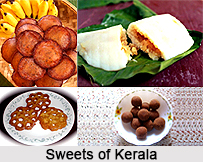 Onam Items Onam Items
Sadya is a typical lunch which is had during occasions. A Sadya is served on a banana leaf in a clockwise manner. It is complemented by "Payasam", a sweet dessert. Payasam is the most popular dessert. Popular snacks include "Unniappam", "Pazham Pori" and "Kozhukkattai", "Murukku", "Pakkavad", "Achappam", "Banana Chips", "Halwa" and many more to be mentioned. Sweets of Kerala A distinctive and unusual sweet is "Mutta Mala", chain like strings of egg yolk cooked in sugar syrup but later removed from it, and frequently served with a snow like pudding called "Pinnanthappam" made from the separated egg whites which have been whisked up with the remaining sugar syrup, steamed and cut into diamond shapes. |
| |||



Cuisine of Kerala
| Cuisine of Kerala comprises both vegetarian and non vegetarian dishes. This cuisine is a mixture of native and foreign dishes adapted to the taste of Kerala. |
| ||||||||||||||||||||||||||||

