


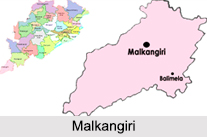
 History of Malkangiri is closely associated with the incredible mythologicalhappenings. Malkangiri, the land of dense inaccessible forest, small and beautiful rivers, undulating plateaus and a rich tribal culture has a rich and thrilling historical background. History of Malkangiri is closely associated with the incredible mythologicalhappenings. Malkangiri, the land of dense inaccessible forest, small and beautiful rivers, undulating plateaus and a rich tribal culture has a rich and thrilling historical background.
As it is contemplated by the eminent historians, the chronicle of the Malkangiri district was documented far back at the time when the human civilization inhabited the region 2500 years back. Prior to the modern civilization, there are glimpses in history indicating the Malkangiri district as a mythological site. Legends of Malkangiri According to the legends, the origin of Malkangiri, Odisha belongs to a mythological King Putraka who created Malkangiri by magic for his queen Patali. The history of Malkangiri started around the year 490 BC when Ajatashatru, the king of Magadha who wanted to move his capital from Rajagriha to a more well located place to battle with the Licchavis of Vaishali. He chose the location on the bank of Ganges and prepared the area. From that time, the cityhas had a constant history, a record claimed by few cities in the world. Gautam Buddha passed through this place in the last year of his life, and he had prophesized a great future for this place. As the conventional belief runs, the district of Malkangiri occupied a significant importance during the reign of Lord Rama Chandra and it shares a considerable part in the epic Ramayana. The district of Malkangiri was known as "Malyavantagiri" in the Ramayana from where the river Tamasa flows. Following the historical legends of Malkangiri district the river Tamasa, and its pictorial environs, encourages saint Valmiki to express his inner feelings in Ramayana. The credential fact that lord Rama visited the land is strengthened by the existence of "Sitakunda" the bath place of Goddess Sita near Mudulipada, Odisha. In the Mahabharata also the region of Malkangiri draws a special significance. As the legendary chronicle runs the Malkangiri district was the point of attraction for the Pandavas. They spent their "Angyatvasa"(exile) for a period of one year in the dense forest of Malkangiri. Around the year 1995, some monuments, which have been deciphered in the region adjacent to the river Tamasa, signify the fact that the history of Malkangiri is closely knitted with the Indus Valley Civilization. Parallel to the Indus Valley Civilization in Mohanjedaro and Harappa, a rich civilization was also flourished in the extensive region of Malkangiri. Also a big "Shiva Linga" was discovered from beneath the ground, signifying the association of this civilization with that of Indus Valley. The ancient kings of this place during the early Vedic and later Vedic period worshiped Lord Mallikeshwar. This Mallika Nagari gradually became Malkangiri in the modern times. The Malkangiri district is named after the ancient kingdom of Mallika Nagar. Quite a good number of Shiva lingam, which has been excavated in the region of Malkangiri implies the fact that the ancient kings were Saivas. Malkangiri as Rising Kingdom Malkangiri was flourished as a hilly kingdom during the reign of the "Ganga Dynasty" and it was known as "Kumbudiri" as is mentioned by the first Collector of Koraput District Mr. R.C.S. Bell in gazetteer, 1941. Though the authentic written historical records are documented from this very period, there is enough evidence, supporting that the wild forest country of Malkangiri is known for a former civilization. In Kondakamberu two inscriptions have been excavated recording a gift to the God Nilakantheswar by the queen of Pandu Singh in the year 1376 A.D. Kondakamberu was formerly known as "Kumbudiri". It has been assumed after a thorough consideration of the history of Malkangiri that the ancient region of Kondakamberu and the present Malkangiri are same. During the period of 1400 to 1872 A.D., 26 kings have colonized this princely state of Malkangiri successively, during whose reign the entire state was divided into four ‘Muthas’ namely ‘Mout’, ‘Podia’, ‘Korukonda’ and ‘Padmagiri’. The chief of each Mutha was called Mutadhar. Again each ‘Mutha’ was divided into a number of villagesunder the administrative head ‘Peda’. At the helm of the administration was the king. The history of Malkangiri depicts the democratic set up of the ancient kingdom of Malkangiri. Ruins of the temporary castles dotted over the district indicate the socio- political conditions of the ancient Malkangiri. The last Queen of Malkangiri, Bangaru Devi ruled over here from 1855 A.D. to 1872 A.D who defeated King Ramachandra Deva III of Jeypore, Odisha by her powerful and extra-ordinarily competent Koya Army. She along with her Koya Army fought bravely against the mighty British Army and finally deposed in 1872 A.D, resulting a complete accession of Malkangiri State into Madras Presidency. The annexation of the Malkangiri state with Madras Presidency is the beginning of the history of British regime in Malkangiri. After the Queen passed away, there was a long gap of 35 years (from 1880 to 1915) in the history of Malkangiri and it became again rose in prominence in the political scenario when the rebel groups again tried to fight against British Empire in and around Malkangiri. Unifying all the small rebel groups, Alluri Sitarama Raju established a big Guerrila Troop and struggled against the British Army. Apart from the tribal rebellion, the history of Malkangiri depicts the contribution of the noted freedom fighters in India. Malkangiri played a significant part in the Indian Independence Struggle. Prior to 1936, Malkangiri was a part of Madras Presidency. In 1936, when Koraput district was merged with Odisha, the Malkangiri subdivision was adjoined with the Koraput district as a ‘Tahsil’ and Mr.R.C.S. Bell became the first English Collector of Koraput District in the year 1941. Again it became a Taluk of Nabrangpur districtas a tribal ‘Tahsil’. In 1962, the Malkangiri subdivision came into existence according to the prior notification of 1958, Dandakaranya Development Project, which was implemented to settle the refugees coming from East Pakistan. Finally the present district of Malkangiri came into existence, with the status of a separate functional unit in 2nd October 1992 following the Notification No. 49137/R dated 01.10.1992 of Odisha government in Revenue and Excise Department, Odisha. |
| |||



Home > Travel > States of India > Odisha > Districts of Odisha > Malkangiri District > History of Malkangiri
History of Malkangiri
| The rich and adventurous history of the Malkangiri district, Odisha echoed the mythological episodes which took place in the ancient India. |
| ||||||||||||||||||||||||||||

