Charkula Dance
|
Charkula Dance is the most spectacular dance performance which is widely performed in the Braj region of Uttar Pradesh, by the Brahman Community in Mathura district.
|
|
|
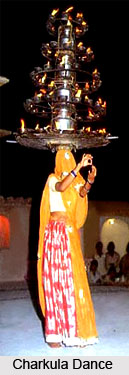 Charkula dance is a dramatic dance performance that is visually attractive. The dance owes its birth to Lord Krishna era. In the performance of Charkula, veiled women balance a large multi-tiered circular wooden pyramid on their heads and dance in various steps. The wooden pyramid is lighted with 108 oil lamps. These women dance on the 'Rasiya' songs of Lord Krishna. Charkula dance is a dramatic dance performance that is visually attractive. The dance owes its birth to Lord Krishna era. In the performance of Charkula, veiled women balance a large multi-tiered circular wooden pyramid on their heads and dance in various steps. The wooden pyramid is lighted with 108 oil lamps. These women dance on the 'Rasiya' songs of Lord Krishna.
Charkula dance is especially performed on the third day after the Holi festival, which is the Dooj, since this was the day, when Radha, was born. According to a famous legend, Radha's grandmother ran out of the house, keeping the Charkula on her head to announce the birth of Radha. Since then, Charkula has formed as a popular dance form of Brajbhoomi and here; it is performed during various festivals. However, there is another myth related to the dance form. It is believed that the Charkula dance celebrates the happy victory over Lord Indra by Krishna and the cowherd community of Braj. This dance is considered to be a symbol of happiness and joyful rapture. Dancers enact the Govardhan Leela by putting 50 Kilogram Charkula on their head during the performance. Rasiya is a rich tradition of folk-songs of the Braj area that describe the love of the divine couple Radha and Shri Krishna.
The Charkula is a tapered wooden column with four to five circular tiers. On each level it has lighted earthen lamps, whose number may range from 51 to 108 ones. In the dance performance female dancers tactfully balance a column of lighted deepikas over their heads while dancing. The dancers balancing the Charkula on their head move with swift and graceful movements on the tune of music. The dancing damsels also cover her body and face with the odhni. They hold lighted lamps in both their hands. Their movements are limited because of the heavy load on the head. The dancers cannot bend their body, nor can they move her neck. In spite of these limitations the slim, sturdy and courageous dancers dance, gliding, bending, and pirouetting to the tune of the song. The climax is reached when enraptured by the collective merriment of the occasion, the singers also start dancing. The swift beat of music and movement enthrall the audience thus they find themselves carried away by the jubilation and the wonderful rhythm.
It is one of the most magnificent dance performances among the Indian tribal dances.
|
|
|
|





