Bahá`í Lotus Temple, Kalkaji, New Delhi - Informative & researched article on Bahá`í Lotus Temple, Kalkaji, New Delhi
  Indianetzone: Largest Free Encyclopedia of India with thousand of articles Indian Temples


in  
Art & Culture | Entertainment | Health | Reference | Sports | Society | Travel
Forum  | Free E-magazine
Indian Temples : Indian Temples l Arts and Crafts of Hindu Temples l Indian Religious Temples l Churches in India l Mosques in India l Shiva Temples In India l Krishna Temples in India l Hanuman Temples in India l Durga Temples in India l Vishnu Temples in India l North Indian Temples l Central India Temples l West India Temples l East India Temples l Indian Regional Temples l Indian Temple Managements l Styles of Worship in Indian Temples l Indian Temple Architecture l Indian Temples by Religion l History of Indian Temples l Hindu temples in India l Gurudwaras in India
Home > Reference > Indian Temples > North Indian Temples > Temples of Delhi > Bahá`í Lotus Temple
Bahá`í Lotus Temple, Kalkaji, New Delhi
Bahá`í Lotus Temple, established in 1986 is famous for its archetectural wonder.

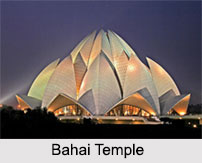
Bahá`í Lotus Temple, Kalkaji, New Delhi The Bahá`í House of Worship in Delhi, popularly known as the Lotus Temple is a spectacular place of worship in the city. Completed in 1986, it serves as the Mother Temple of the Indian Subcontinent. It has won uncountable architectural awards and has featured in hundreds of newspapers and magazine articles. The Bahá`í Faith is the youngest of the world`s independent religions;it emphasizes the spiritual unity of all humankind. It was founded by Bahá`u`lláh (1817-1892) in 19th century Persia, is regarded by the Bahá`í`s as the most recent in the line of Messengers of God that stretches back beyond recorded time and includes Abraham, Moses, Buddha, Zoroaster, Christ and Muhhamad. The fundamental theme of Bahá`u`lláh message is that humanity is one single race and that the day has come for its confederation in one global society. God, Bahá`u`lláh said, has set in motion historical forces that are breaking down traditional barriers of race, class, creed and nation and that will, in time, give birth to a universal civilization. The principal challenge facing the people of earth is to accept the fact of their oneness and to assist the processes of unification.

One of the purposes of the Bahá`í Faith is to help make this possible. A worldwide community of some five million Bahá`ís, representative of most of the nations, races and cultures on earth, is working to give Bahá`u`lláh`s teachings realistic effect. Their experience will be a source of encouragement to all who share their vision of humanity as one global family and the earth as one motherland. Bahá`í houses of worship are open to all people. Although their architectural styles differ widely, the nine sides and central dome, common to all of them, symbolise at once the diversity of the human race and its essential oneness. Devotional programmes are simple, comprising prayers, meditations and the reading of selections from the sacerd scriptures of the Bahá`í Faith and other world religions.

Inspired by the lotus flower, built out of marble, cement, dolomite and sand, the Bahá`í Lotus Temple`s design is composed of 27 free-standing marble clad `petals` arranged in clusters of three to form nine sides. The architect was an Irian, who lives in Canada, named Fariborz Sabha. The major part of the funds needed to buy this land was donated by Ardishír Rustampúr from Hyderabad, who gave his entire life savings for this purpose in 1953. This House of Worship is generally referred to as the `Lotus Temple` by Bahá`ís and non- Bahá`ís alike. In India, during the Hindu festival Durga Puja, several times a replica of the Lotus Temple has been made a pandal, a temporary structure set up to venerate the goddess Durga. Nine doors open onto a central hall, capable of holding 2500 people. Somewhat more than 40 metres tall, its surface shining white marble, the temple at times seems to float above its 26 acre (105,000 sq. mt., 10.5 ha) nine surrounding ponds.The site is in village of Bahapur, in the National Capital Territory of Delhi. Since its inauguration to public worship in December 1986, the Bahá`í House of Worship, as of late 2002, has attracted more than 50 million visitors, making it one of the most visited buildings in the world. Its number of visitors during those years surpassed those of the Eiffel Tower and the Taj Mahal. On Hindu holy days, it has drawn as many as 150,000 people; it welcomes four million visitors each year (about 13,000 every day- wikipedia encyclopedia).

This Bahá`í Lotus Temple joins six other Bahá`í temples around the world, in terms of constructional similarity. Each of these houses, while sharing some basic concepts, has its own distinct identity embodying the principle of unity in diversity. The structure of the Lotus Temple of New Delhi, is composed of three ranks of nine petals,each springing from a podium elevating the building above the surrounding plain. The first two ranks curve inward, embracing the inner dome; the third layer curves outward to form canopies over the nine entrances. The petals, constructed of reinforced white concrete cast in place, are clad in white marble panels, performed to surface profiles and patterns related to the geometry. Nine arches that provide the main support for the superstructure ring the central hall. Nine reflecting pools surround the building on the outside, their form suggesting the green leaves of the lotus flower. Translating the geometry of the design, in which there are virtually no straight lines, into the actual structure presented particular challenges in designing and erecting the framework. Not only was it difficult to align, so as to produce accurately the complex double-curved surfaces and their intersections, but also the closeness of the petals severely restricted workspace. Notwithstanding, the task was carried out exclusively by the local labourers. To avoid construction joints, petals were concreted in an uninterrupted operation for approximately 48 hours. All the steel reinforcing for the shells of the lotus petals was galvanised to avoid rust stains on the white concrete in the prevailing humid conditions, ensuring the life of the delicate shell structure of 6 to 18cm thick shells of the petals. The Indian visitors, ranging from the most sophisticated to the most simple, expressed perplexity at the absence of any idols. It has been quite an uphill task to make them understand that the all-pervasive Almighty cannot be moulded into any limited

(Last Updated on : 8/09/2010)
  More Articles in Temples of Delhi
 
Bahai Temple Bahá`í Lotus Temple Laxminarayan Temple
Akshardham Temple Chattarpur Mandir Ramakrishna Mission
Hanuman Mandir ISKON Temple Digambar Jain Lal Temple
Uttara Swami Malai Temple Kali Bari Mandir Kalkaji Temple
Gauri-Shankar Temple Sheetala Devi Temple Sivanand Yoga Vedant Natraja Centre
Recently Updated Articles in Indian Temples
  • Har Ki Pauri
    Har Ki Pauri is a well known ghat on the banks of the Ganges in Haridwar in the state of Uttarakhand.
  •  
  • Neelkanth Mahadev Temple
    Neelkanth Mahadev Temple is dedicated to Nilkanth or Lord Shiva. It is situated in the Pauri Garhwal district of Uttarakhand.
  •  
     
  • Mansa Devi Temple
    Mansa Devi Temple is a Hindu temple dedicated to goddess Mansa. It is situated in the holy city of Haridwar in Uttarakhand.
  •  
  • Chandi Devi Temple
    Chandi Devi Temple is a temple that is dedicated to Goddess Chandi Devi situated in Haridwar in Uttarakhand.
  •  
  • Baleshwar Temple
    Baleshwar Temple is ancient temple that is dedicated to Lord Shiva. It is situated within the city of Champawat in Uttarakhand.
  •  
    E-mail this Article | Post a Comment
    RSS Feeds
    Forum
    Forum on Indian Temples

    Free E-magazine
    Subscribe to Free
    E-Magazine on Indian Crafts
     
     
    Bahá`í Lotus Temple, Kalkaji, New Delhi - Informative & researched article on Bahá`í Lotus Temple, Kalkaji, New Delhi
    Sitemap
    Contact Us   |   RSS Feeds
    Copyright © 2008 Jupiter Infomedia Pvt. Ltd. All rights reserved including the right to reproduce the contents in whole or in part in any form or medium without the express written permission of Jupiter Infomedia Pvt. Ltd.