


 Aromatherapy oils are known as the essence of plants. Hence they should be extracted in such a manner that their inherent properties are not lost. There can be different methods of extraction for different plants and oils. Teas, tinctures, decoctions, infused oils, herbal beers, and wines all extract and concentrate the volatile components of the plants but these are not aromatherapy oils. Aromatherapy oils are much more concentrated, and are produced by steam distillation, cold pressing, C02 hyperbarlic extraction, and solvent extraction. Each method has its advantages and disadvantages and produces a different quality of oil. Aromatherapy oils are known as the essence of plants. Hence they should be extracted in such a manner that their inherent properties are not lost. There can be different methods of extraction for different plants and oils. Teas, tinctures, decoctions, infused oils, herbal beers, and wines all extract and concentrate the volatile components of the plants but these are not aromatherapy oils. Aromatherapy oils are much more concentrated, and are produced by steam distillation, cold pressing, C02 hyperbarlic extraction, and solvent extraction. Each method has its advantages and disadvantages and produces a different quality of oil.
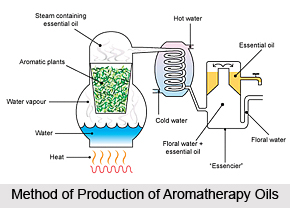
Steam Distillation: It is the most common method of aromatherapy oil extraction. Distillation uses the extraction abilities of steam and sometimes pressure, to pull the aromatic qualities from the plant material. The chosen plant material is placed on screens over boiling water, or super-heated steam from another source is piped through the plant material. As the steam passes through the plant material, the volatile components are lifted, condensed in a cooling coil and precipitate out as a combination of distilled water and volatile components. The mixture is collected in a Florentine vase (which has an hourglass shape) and in most cases the distilled water is heavier and sinks to the bottom, while the aromatherapy oils, being lighter, rise to the top, at which point a valve can be opened and the oils drain off. 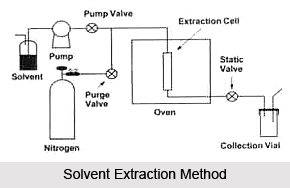 There are very primitive methods of steam distillation that use very low heat and may take as long as a month to distill one batch of aromatherapy oils. The advantage in "slow" distillation is that the long time (and patience) allows some of the larger molecules to be gently coaxed out and can produce an essence that has a wider range of smells. More modem methods of distillation may use higher temperatures to very quickly extract essential oils, sometimes in a matter of minutes. This can produce oils quickly, cheaply and efficiently; however, the bouquet, or range of smells, is somewhat restricted by this method, and involves a loss in some of the possible therapeutic qualities.
Cold Pressing: It is the second most common method of aromatherapy oil production. The rinds, or in some cases the whole fruit, are chopped or ground, and pressed to extract the aromatherapy oil components that are found in the skin of the fruit. In early days, and in some places in the world today, the rinds of these fruits were squeezed into sponges. Take a piece of citrus rind, fold it, skin out, and notice the spray of essential oils (watch your eyes). This production method is most useful in the processing of citrus rinds such as lemon, orange, grapefruit, tangerine, bergamot and mandarin. Cold pressing produces a combination of aromatherapy oils and watery components, which can be allowed to separate and the essential components collected. The mechanical nature of this process produces essential oils that are not as pure, and tend to oxidize or lose their potency if un-refrigerated for more than two years. Steam distilled essential oil, on the other hand, will grow richer in smell over the years and in some cases have unlimited shelf life. The CO2 Hyperbaric Production Method: This method utilizes as much as 22 atmospheres of pressure in the presence of pure CO2 gas. At high pressure the CO2 becomes liquid and has the ability to extract the essential oil components from the plant material. This liquid is drained off and allowed to depressurize, at which point the CO2 becomes a harmless gas. The pure essential oil is left in the bottom of the chamber. This method is especially useful in some of the lighter fragrances such as jasmine or Tuberose where the flowers have light, easily lost aromatic components. The cost of the compression equipment is great and oils produced are more expensive than steam distilled. The Solvent Extraction Method: This method is useful while extraction essence from light aromatic flowers. The flowers are collected and a solvent such as hexane is poured over them. In the next step, the solvents are evaporated using a vacuum, and what's left is very thick, sticky residue known as a "concrete." The concrete can be dissolved in alcohol, the alcohol pulled off and the remaining essential oil is known as an "absolute." This method does not involve heat, pressure, or mechanical pressing which can change the odor of the flowers. That is the reason perfumers like this method the most. Perfumers maintain that absolutes are more true to the original smell of the flower than oils produced using any other method of production Aromatherapists. However, a small amount of the petroleum solvent always remains and can be harmful to the human immune system causing reactions in sensitive people. In aromatherapy, it is the method least preferred, and oils produced in this manner are never used internally. |
| |||



Home > Health > Naturopathy > Aromatherapy > Aromatherapy Oils > Production Methods for Aromatherapy Oils
Production Methods for Aromatherapy Oils
| There can be different methods of extraction for different plants and oils. |
| ||||||||||||||||||||||||||||

